Anthropic's Amended S-1: $17 Billion Quarter, $895 Billion Committed
Anthropic filed the first amendment to its IPO registration statement on November 2. It answers two of the seven numbers we said would decide the deal: third-quarter revenue and the total of its compute commitments. It still has no price range, no share count and no deal size, so this is not yet the amendment that starts the roadshow.
Two things in it change the picture from a week ago. The profit in the June quarter did not repeat, and the commitments are larger than we estimated. You can follow the terms as they come in on the Anthropic card on our IPO tracker.
The Short Version
- Revenue reached $17.0 billion in the third quarter, up 47 percent from the second and 12.3 times the same quarter a year earlier. It added $5.4 billion, less than the $6.8 billion it added in the second quarter, the first smaller step in the seven quarters the filing shows.
- The operating profit did not repeat. Operating income of $974 million in the June quarter became an operating loss of $567 million. The company points to $5.0 billion of short-term compute and a $2.0 billion non-cash charge for matching employee donations.
- Compute took 58 percent of revenue, up from 48 percent, and the company expects more short-term buying to compress its margins in the near term.
- Commitments total $895.4 billion and run through 2045, with half expected by the end of 2030 and $69.8 billion due in the 12 months after September 30, against $131.8 billion of cash and short-term investments. Another $150 billion to $175 billion sits outside that total.
- The filing's fair values point to about $70 a share, against $58.90 in the Series H round. By our rough math that is about $1.2 trillion. The filing does not state a valuation, and this is not an IPO price.
- There is new language on safety. Based on internal estimates and its expectations for future models, Anthropic says it may imminently meet a threshold in its Responsible Scaling Policy that concerns AI speeding up its own research.
The Third Quarter
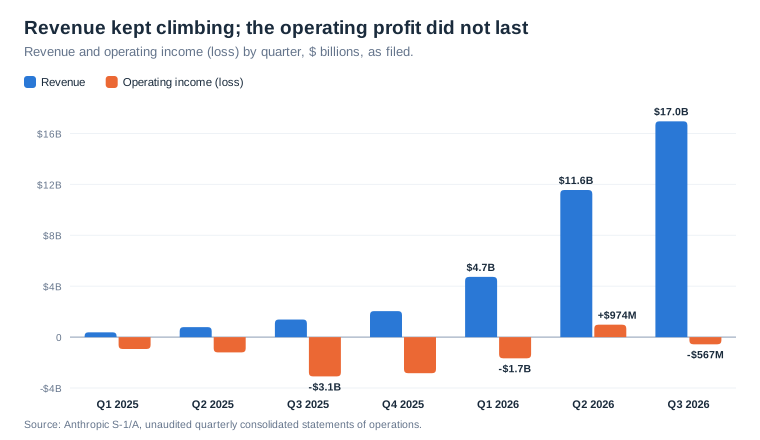
| $ millions | Q4 2025 | Q1 2026 | Q2 2026 | Q3 2026 |
|---|---|---|---|---|
| Revenue | 2,040 | 4,731 | 11,555 | 16,956 |
| Compute and infrastructure | 2,945 | 3,387 | 5,558 | 9,863 |
| Operating income (loss) | (2,836) | (1,667) | 974 | (567) |
| Adjusted operating income (loss) | (1,721) | (617) | 2,235 | 2,463 |
| Adjusted operating margin | (84)% | (13)% | 19% | 15% |
| Net loss | (16,858) | (14,439) | (66,309) | (23,291) |
Revenue. Third-quarter revenue of $17.0 billion brings the nine-month total to $33.2 billion, against $2.5 billion a year earlier. The filing says price reductions took about $600 million out of the quarter, through cheaper new model versions and contractual discounts. Usage more than made up for it. The company still expects its growth rate to decline over time, and it may also lose revenue as it enforces its usage policy more tightly. Its estimate of revenue from customers later found to be breaking that policy is unchanged, at 5 to 7 percent of the first nine months.
The operating loss. The filing names two main causes. The first is $5.0 billion of compute bought under short-term commitments, covered in the next section. The second is a $2.0 billion non-cash charge for the program that matches employees' donations of their equity. That program cost $126 million in the first half, and the company expects spending on its public benefit work to grow.
Adjusted operating income, which leaves out stock-based compensation and the donation charge, rose to $2.5 billion from $2.2 billion. The margin still fell to 15 percent from 19 percent, which the filing puts down mainly to the short-term compute.
Gross margin held. On the same calculation as our first piece, it was 86 percent in the quarter, with cost of revenue at $2.4 billion. We get the quarter by subtracting first-half figures from the new nine-month figures. Research and development was $9.5 billion, about as much as in the whole first half.
Sales and marketing costs eased as a share of revenue. Sales, marketing and partnerships fell to 14 percent of revenue from 22 percent in the first quarter. The filing credits a smaller share of revenue coming through channel partners and changed terms with those partners. Cloud marketplaces carried 44 percent of revenue over the nine months, against 48 percent in the first half.
The net loss was $23.3 billion, and $21.9 billion of it is the same non-cash item as before, the rising fair value of Amazon's convertible notes. Income taxes became a real line for the first time, at $396 million, mostly state and foreign taxes.
Cash. Operating cash flow was $2.6 billion in the quarter and $6.6 billion over nine months. By our count about $2.3 billion went to equipment, prepayments on leased assets and other investing, and the company raised no new money from investors, so cash and short-term investments barely moved, at $131.8 billion. The filing warns that its build-out will be a significant use of cash for the foreseeable future.
Revenue per Dollar of Compute
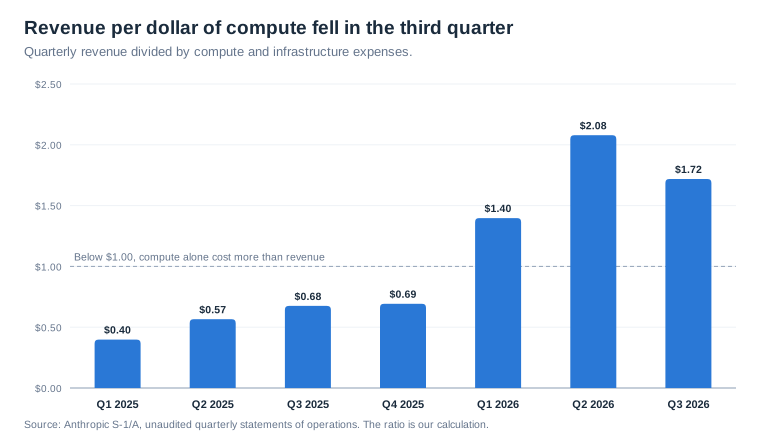
This ratio is the core of Anthropic's case that its compute is efficient, and it is still the only check on number seven on our list, since the filing gives no capacity figure in megawatts or chips. The company's own version compares growth rates: revenue up 1,127 percent from a year earlier against compute expenses up 382 percent. In the first filing, for the June quarter, those were 1,368 percent and 300 percent.
The amendment now says plainly that revenue per dollar of compute fell from the previous quarter. Of $9.9 billion of compute expense, $5.0 billion was short-term, up from about $1.5 billion in the whole first half, by our subtraction.
The reason is timing. Anthropic usually buys compute 12 to 18 months before it arrives, under multi-year contracts. When demand or research needs run past that capacity, it buys short-term compute, which it says costs significantly more. That is a sign of demand and a cost at the same time. The company expects short-term use to keep rising in the near term and to compress its margins. It had $17.4 billion of short-term contracts at September 30 and signed $6.6 billion more after that date.
What Makes Up $895.4 Billion
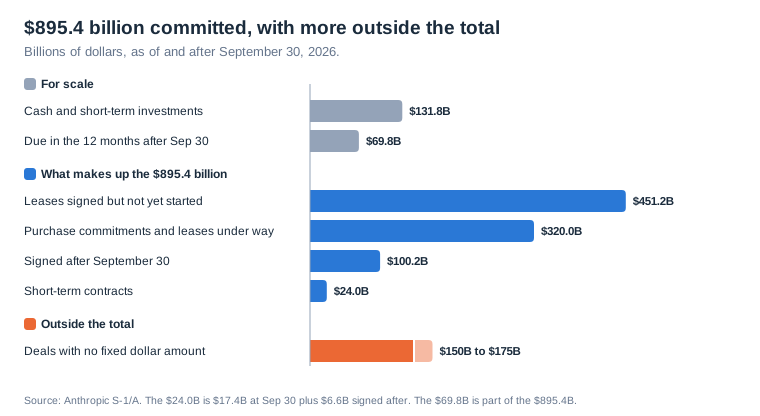
The total is larger than the figure in our first piece, and it measures something wider. We added up only the agreements the S-1 named and arrived at about $780 billion. The same sum on the amendment gives about $790 billion to $815 billion, after Google's minimum rose to $121.3 billion from $114.5 billion.
The company's own total also covers short-term contracts and agreements it does not describe, without saying how large those are. It excludes $150 billion to $175 billion because the payments depend on capacity, delivery and pricing. With those, the fuller figure is about $1.05 trillion to $1.07 trillion. The filing does not itemize that range, but it describes two such deals: additional TPU compute, estimated at $125 billion to $150 billion, and systems from AMD, at more than $20 billion if it takes the full first tranche.
Three details matter more than the headline.
How much is firm. $213.8 billion of the total can be terminated or depends on conditions, such as a counterparty securing financing, facilities or regulatory approval.
How fast it is growing. Leases signed but not yet started rose to $451.2 billion from $321.4 billion at June 30, and $100.2 billion more was added by new or amended agreements in the month after September 30.
What is behind it. A significant portion of the total is what the company calls Anthropic Direct: leasing chips and hosting them in dedicated facilities rather than buying from cloud providers alone. A new sentence warns that some of its compute suppliers rely on outside financing themselves, and that if the financing falls through, contracted capacity may be delayed, repriced, reduced or not delivered.
When It Comes Due
The $895.4 billion runs through 2045, about 19 years from September 30, 2026. Half, $447.5 billion, is expected by the end of 2030, and nearly all of the rest from 2031 to 2045. The filing says "substantially all" of that remainder, so a small amount could fall outside those years.
| Period | Amount | Share | Rough pace |
|---|---|---|---|
| 12 months after September 30 | $69.8 billion | 8% | $69.8 billion in the year |
| From then through 2030 | about $378 billion | 42% | about $116 billion a year |
| 2031 to 2045 | about $448 billion | 50% | about $30 billion a year if spread evenly |
The middle and last rows are our arithmetic from the filing's $447.5 billion through 2030. The filing gives that figure as incurred and the $69.8 billion as paid, so those rows are approximate. For scale, the first 12 months are about half of the cash on hand before any IPO proceeds, and $116 billion a year compares with third-quarter revenue of about $68 billion at an annual rate.
The later years are probably not even. The filing gives no year-by-year figures after 2030. The largest piece of the total is $451.2 billion of leases that generally start between 2026 and 2028, with terms of up to 20 years and a weighted average of about 10. Our inference is that the spending after 2030 falls mostly in the 2030s and thins out by the 2040s.
A yearly schedule exists for only $320.0 billion of the total. Payments due, in billions of dollars:
| Q4 2026 | 2027 | 2028 | 2029 | 2030 | After 2030 |
|---|---|---|---|---|---|
| 5.2 | 29.2 | 44.4 | 47.8 | 45.1 | 148.4 |
What could change the timeline:
- Could be cancelled. $213.8 billion can be terminated or depends on conditions, so some of it may never be spent.
- Could shift. Much of the capacity has not been delivered, and the filing warns that payment timing, and in some cases amounts, may differ from that schedule.
- Not in the total. Another $150 billion to $175 billion has no dates, only that it is "payable over time after the capacity is delivered."
- More to come. Anthropic expects to keep signing similar agreements, so this is what is committed today, not a full forecast of its spending.
To pay for it, the company lists $146.6 billion of liquidity, including a revolving credit line with $14.8 billion available, and up to $77.0 billion of further notes: $20 billion from Google, $15 billion from Amazon and $42 billion to help with rent on the Broadcom leases. AMD has also committed to buy up to $5.0 billion of stock if certain conditions are met. All of that excludes IPO proceeds, though the note facilities carry conditions, Google's can shrink by up to $10 billion if it uses its stock option, and the company expects to issue none of the $77.0 billion before the offering. The company says its cash, short-term investments, cash from sales and credit line will cover at least the next 12 months. By our reading the 12-month bill fits for now. The question our first piece raised is the years after that.
About $70 a Share
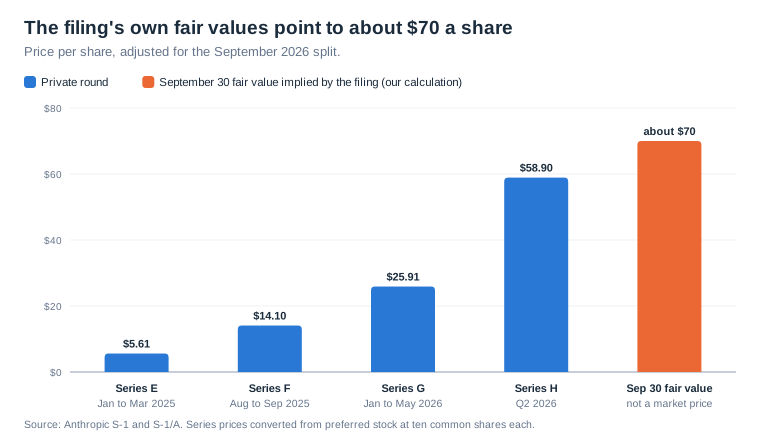
The filing still has no price range, but three of its September 30 figures imply a value per share, and they agree closely.
| What the filing reports | Amount | Shares | Per share |
|---|---|---|---|
| Fair value of the convertible notes | $130.5 billion | 1.84 billion | $70.91 |
| Option intrinsic value, plus the $2.91 average strike | $119.1 billion | 1.77 billion | $70.04 |
| Donation match liability, settled in stock in October | $1.96 billion | 27.99 million | $70.02 |
The first line can be checked against June. The same division gives $58.99 at June 30, almost exactly the $58.90 Series H price. The whole $21.9 billion fair value charge for the third quarter is that move from about $59 to about $71. Separately, the company's estimated fair value in option grants this year reached $68.54.
On the roughly 16.9 billion fully diluted shares we estimated last time, about $70 is about $1.2 trillion, or about 17.5 times third-quarter revenue at an annual rate.
Treat that with care. These are the company's own estimates for its accounts, not prices anyone paid, and the share count is a June figure. The price will come out of negotiations between the company, the selling holders and the underwriters, and it could land above or below this. What it does give is a second reference point: when the range arrives, compare it with $58.90 and with about $70.
New Language on Safety
The most notable new wording is not in the financial statements. Anthropic says its internal estimates, and its expectations for future models rather than current ones, indicate that it may imminently meet its Responsible Scaling Policy's definition of "dramatically accelerated progress attributable to AI." It says it has not designated any current model as past that threshold, is still assessing the data, and will publish further reports.
Elsewhere, the first filing said model capabilities could advance to the point of triggering enhanced safety measures under that policy. The amendment says they may already have. It adds that the company does not expect to be able to safely use Claude to design and build future frontier models fully on its own without meaningful human supervision or understanding, if and when that becomes technically possible, and that it is considering policy changes to keep humans in control, including human review and approval of certain research decisions.
For shareholders this is not abstract. Safety work can slow the business: both filings say Anthropic recently delayed pre-training a new frontier model by more than a month to improve its security.
The Deal, Still Without a Price
One new section speaks directly to individual investors. Anthropic expects part of the offering to go to retail buyers at the IPO price through brokerages including Fidelity, Robinhood, SoFi, E*TRADE from Morgan Stanley and Trade-PMR, on their online platforms among other ways. It does not say how many shares.
Here is where the seven numbers stand.
| Number | Status after the amendment |
|---|---|
| 1. The price range against $58.90 | Still blank |
| 2. Third-quarter revenue and run-rate revenue | $17.0 billion; run-rate revenue as of October 31 is still blank |
| 3. The size of the deal and how much is insiders selling | Still blank |
| 4. Google's $10 billion option | Unchanged and still open |
| 5. The commitment total and the next 12 months | $895.4 billion and $69.8 billion |
| 6. The lock-up share counts | Still blank; the percentages have not changed |
| 7. Any capacity figure | Still none |
Another amendment has to fill in the rest before the shares can price. We will write up the range when it lands, and the Anthropic card on the IPO tracker will carry the terms as they come in.
How we measured: financial figures are as filed in Anthropic's Form S-1/A of November 2, 2026; amounts for 2026 interim periods are unaudited. Third-quarter gross margin, research and development, operating cash flow and investing outflows other than short-term investments subtract the first-half figures in the October 26 S-1 from the nine-month figures in the amendment; first-half short-term compute subtracts the third quarter's $5.0 billion from the nine-month $6.5 billion. Revenue per dollar of compute divides quarterly revenue by quarterly compute and infrastructure expenses. Per-share values divide the reported amounts by 1,840.4 million note shares, 1,774.3 million options and 27.99 million donation match shares; the notes and the donation match are Class N shares, which carry the same economic rights as Class A. The $1.2 trillion uses about $70 and 16.9 billion fully diluted shares, estimated from the Public Benefit Fund's 846.8 million shares at 5 percent as of June 30.
This piece is for informational purposes only and is not investment advice. Figures are as of November 2, 2026, and the filing will change before the shares are priced.
Comments (0)
No comments yet. Be the first.