Anthropic's S-1: $141 Billion Raised, $132 Billion Unspent
Anthropic has raised $141 billion, still holds $132 billion of it, and just reported an $80.7 billion loss for six months' work. All three numbers are in the registration statement the company behind Claude filed with the SEC on October 26, to sell Class A shares on the Nasdaq Global Select Market under the ticker ANT, and all three are true at once. Working out how is most of what this piece is about.
The filing leaves out what most people look for first: the price range, the number of shares and the size of the deal. Those usually arrive in an amendment as the roadshow begins, with Goldman Sachs and Morgan Stanley leading a syndicate of 22 banks. What it does contain is three and a half years of financial history, about 95 pages of risks, and the most unusual governance structure we have seen in a large IPO. We go through it in order: where the money went, how fast the business is growing and why, what it costs to run, the quarter it turned a profit, why an operating loss of $693 million became a net loss of $80.7 billion, what private investors paid, who holds the votes, and how the lock-up leaks from day one. We close with how this year's other billion-dollar IPOs have traded, the seven numbers that will decide this one, and what happens next.
You can follow the deal terms as they come in on the Anthropic card on our IPO tracker.
The Short Version
- Revenue is up 14 times in a year. $16.3 billion in the first six months of 2026, against $1.2 billion a year earlier and $41 million in all of 2023. About 80 percent is pay-per-use.
- Serving customers has become cheap. By our calculation, gross margin was 85 percent in the first half of 2026, up from 12 percent a year earlier. The compute bill has moved into research and development, where the next model is built.
- The June quarter was profitable. A $1.7 billion operating loss in the first quarter became a $974 million operating profit in the second. Operating cash flow for the half was positive $3.9 billion.
- The $80.7 billion net loss has almost no cash in it. $72.4 billion of it is the accounting cost of convertible notes, mostly Amazon's, becoming more valuable as the company did.
- It has barely touched the money it raised. $141.1 billion raised, $131.7 billion still in cash and short-term investments. Cloud providers, GPU hosts and chip lessors are building the capacity and billing for it over the next decade: at least $780 billion of commitments against that cash.
- Private investors paid $58.90 a share in the second quarter, split-adjusted, 10.5 times the price of early 2025. By our rough math that is about $1 trillion.
- The public gets at most 49.9 percent of the vote. One Class F share held by the seven co-founders carries 50.1 percent, and an independent trust elects a majority of the board.
- The lock-up ends in steps, not on one day, starting with 10 percent for directors, officers and some employees the day after pricing.
- The risks are specific: a risk factor on AI posing "catastrophic or existential risks to humanity," a court fight with the Department of War, two models pulled worldwide in June, revenue from customers breaking the usage policy, and compute commitments that run to 2045.
Where Did $141 Billion Go?
One sentence from the filing has made the rounds: "As of June 30, 2026, we had raised an aggregate of $141.1 billion of capital and had cash and cash equivalents of $112.4 billion and short-term investments of $19.3 billion." Subtract, and a company that went from $41 million of revenue in 2023 to $11.6 billion in a single quarter has used up $9.4 billion in its whole life, and $2.5 billion of that is still sitting on the balance sheet as restricted cash, collateral for its leases and other obligations. The cash flow statement says the same thing: from 2023 through June 2026, operations consumed about $6 billion and capital spending about $630 million.
How can that be? Three reasons, and the third is the one that matters.
Most of the money just arrived. Anthropic raised $110.8 billion through financing in the first half of 2026 alone, most of it in the Series G and Series H preferred rounds. The pile is large partly because it is new.
The business now pays its own way. Operating cash flow was positive $3.9 billion in the half. Before 2026 the company burned cash every year, but never much: the worst year, 2024, used $5.7 billion.
Somebody else is building the data centers. Anthropic has paid for little of its compute up front; the filing says it has financed compute mainly through its cloud providers, and the biggest cash outlay before 2026 was prepaying hosting in 2024. The capacity comes three ways: cloud contracts, where Amazon, Google and Microsoft build it and Anthropic commits to minimum spending over several years; GPU services agreements with SpaceXAI, Nscale and Lambda, which supply the chips and the buildings as a service; and multi-year equipment leases. The largest single agreement, with Broadcom, is a finance lease for TPU systems that others host: the systems land on Anthropic's own balance sheet as they come online, the payments are guaranteed by the parent company and secured by the equipment, and Anthropic has posted cash collateral against them. In every case, someone else spends the capital first, and it comes back to Anthropic as bills that run for years. The total is blank in the main text of the filing, but the individual agreements are not. The chart has the amounts; the fine print is below it.
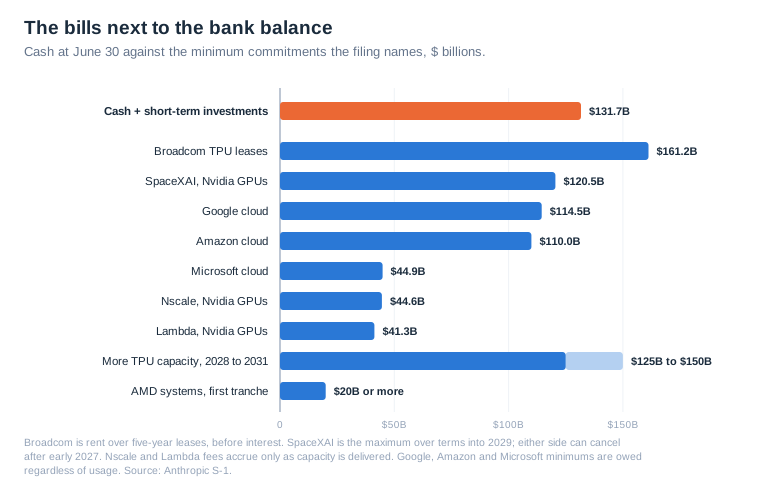
Those add up to about $640 billion. The filing also estimates $125 billion to $150 billion for additional TPU capacity to be delivered between 2028 and 2031, and more than $20 billion under the AMD supply agreement for its first tranche, with an option for about as much again; neither is in its commitments table. Call it $780 billion and up, against $131.7 billion of cash. The terms differ. The SpaceXAI agreements can be cancelled by either side on 90 days' notice after early 2027, and the Nscale and Lambda fees accrue only as capacity is delivered and accepted. The Google, Amazon and Microsoft minimums are owed "regardless of actual usage," and for Google and Amazon, if Anthropic spends less it pays the difference as a true-up.
So the efficiency is real, and so is its shape. The capital-heavy part of this business has been signed for rather than spent, and the bills arrive over the next decade.
The filing never adds it up in one place, but the notes to the financial statements come close: about $417 billion of new and amended minimum commitments between January 1 and June 1, 2026, mostly compute and data center leases and cloud contracts with terms up to 20 years, and about $245 billion more between July 1 and October 26, plus $21 billion of short-term contracts. Those figures overlap with the chart above rather than adding to it, but the point is the scale: about $660 billion of new and amended commitments in ten months of 2026 (the two windows skip June) by a company with $132 billion in the bank. Part is due before the end of 2030 and "substantially all of the remainder" between 2031 and 2045, and the commitments "generally must be satisfied regardless of our revenue or utilization."
Amazon and Google play every role at once: investors through stock and convertible notes, suppliers of much of the compute, sales channels (cloud marketplaces, Microsoft's included, carried 48 percent of revenue in the first half of 2026, up from 11 percent in 2023), and competitors with models of their own. By our count from the filing's share tables, each will own more than 5 percent once the preferred stock and notes convert, in non-voting Class N stock; shares issued under Google's 2026 note agreement stop once they would take Google above 14.99 percent, unless it waives the cap.
The money to cover all this comes from three places. First, the cash. Second, more paper from the partners: Google can still provide up to $20 billion of debt or equity under its 2026 note agreement (less whatever it uses of a $10 billion option to buy stock alongside the IPO, described below), and Amazon's 2026 agreement has $15 billion left; those notes, or the stock they become, are more dilution for public holders. Third, debt arranged but not drawn: a $15 billion revolving credit line, expanded in September, and a Broadcom note facility of up to $42 billion that exists "solely to finance rent obligations" on the 2026 Broadcom lease, at 9 percent interest paid in kind, or 13 percent with a deeper conversion discount for notes issued in a period when revenue conditions are missed. The filing admits that part of the build-out so far "has been funded or supported by capital or credit support provided or facilitated by certain of our CSPs and chip partners," a reliance it says it can reduce over time partly by raising money on its own credit.
The Deal, Minus Its Price
The offering has two parts. Anthropic is selling new Class A shares, and existing holders are selling more. The filing's ownership table puts the co-founders, each holding roughly 230 to 245 million Class A shares, among the selling stockholders; how many shares anyone is selling is left blank. The underwriters also get the usual option to buy extra shares from the company.
The money Anthropic raises will go to "general corporate purposes," which the filing says include working capital, operating expenses and capital spending, specifically compute and infrastructure, and hiring. Part of it will cover taxes owed when restricted stock units held by employees settle at the IPO.
There is also a side deal. Google has an option to buy up to $10 billion of Anthropic's non-voting Class N stock in a private placement alongside the IPO, at the IPO price. If it does, the $20 billion Google can still provide under its 2026 note agreement shrinks by the same amount.
The filing is missing:
- the price range and the number of shares, so the size of the deal and the valuation;
- revenue for the third quarter of 2026 and the company's "run-rate revenue" at the end of October, both of which the text refers to with the number left out;
- the total of its compute and lease commitments;
- ownership percentages for each holder;
- the number of shares in each lock-up release (the percentages are given).
None of that is unusual for a first public filing. It does mean that everything below is a picture of the business, not of the deal.
Fourteenfold in a Year
Anthropic launched commercially in the first quarter of 2023. Revenue was $41 million that year, $386 million in 2024 and $4.6 billion in 2025. In the first half of 2026 it was $16.3 billion, so the company took in more in those six months than in its entire history before them, about three times over.
Most of it is pay per use. Customers pay for tokens, the units models read and write, at a price that depends on the model. That "pay-for-intelligence" revenue was $13.1 billion, or 80 percent, in the first half of 2026; subscriptions such as Claude Pro, Max and the enterprise plans were $3.2 billion. Subscribers who hit their limits can buy more usage, and more enterprise customers are signing multi-year contracts with minimum commitments that mostly show up as usage, so the two blur together.
The customer counts tell the same story. As of September 30, 2026, more than 11,900 customers had paid Anthropic at least $100,000 over the previous twelve months, up from more than 950 a year earlier; more than 1,900 paid at least $1 million and about 250 at least $10 million. Net revenue retention was about 900 percent, meaning the customers who were paying a year ago now spend, as a group, about nine times as much. (The figure leaves out Pro and Max subscribers.)
Coding drives a lot of the expansion. The filing gives one example: in the third quarter of 2026, Claude Enterprise users who didn't use Claude Code spent less than $75 a month on average, while the top 5 percent of Claude Enterprise users who did use it spent about 20 times as much.
Concentration is moderate and falling. No customer accounted for more than 10 percent of revenue in the first nine months of 2026, and the top five together were about 25 percent. In the third quarter, about 79 percent of revenue came from outside the top five, up from 64 percent in the first quarter. The company also notes that revenue from each of its top five customers hit a record in the third quarter, so the share is falling because everyone else is growing faster.
Revenue depends on new models. Model versions released in the six months to September 30 produced more than 80 percent of third-quarter revenue. Customers move to each new model quickly, which is good while the releases keep coming and a risk if one disappoints or slips.
Some of the revenue came from customers who shouldn't have been using the service. Anthropic estimates that 5 to 7 percent of its revenue in the first nine months of 2026 came from customers it later found to be breaking its usage policy or commercial terms. It books that revenue as the service is provided and cuts the customers off once it finds them. It says it tightened detection and enforcement in August and September and expects the share to fall, but it can't say how much that will cost in revenue or growth.
The company is direct that the pace won't last. It says its growth rate will decline over time, possibly "significantly and more rapidly than we anticipate," as the revenue base gets larger and the market matures.
An 85 Percent Gross Margin, With an Asterisk
Anthropic reports its expenses in two ways, and the second one is more useful.
The income statement groups costs by what they are: in the first half of 2026, compute and infrastructure $8.9 billion, people $3.2 billion, sales, marketing and partnerships $3.2 billion, everything else $1.7 billion. Compute was 55 percent of revenue, down from more than 200 percent a year earlier and more than ten times revenue in 2023.
A note to the financial statements regroups the same costs by function, and that is where the economics show:
| $ millions | 2023 | 2024 | 2025 | First half 2025 | First half 2026 |
|---|---|---|---|---|---|
| Cost of revenue | 26 | 752 | 2,773 | 1,019 | 2,380 |
| Research and development | 422 | 2,275 | 6,338 | 1,850 | 9,741 |
| Sales and marketing | 76 | 163 | 911 | 239 | 3,808 |
| General and administrative | 68 | 176 | 1,123 | 190 | 1,050 |
| Copyright settlement | 1,500 | ||||
| Gross margin (our calculation) | 37% | -95% | 40% | 12% | 85% |
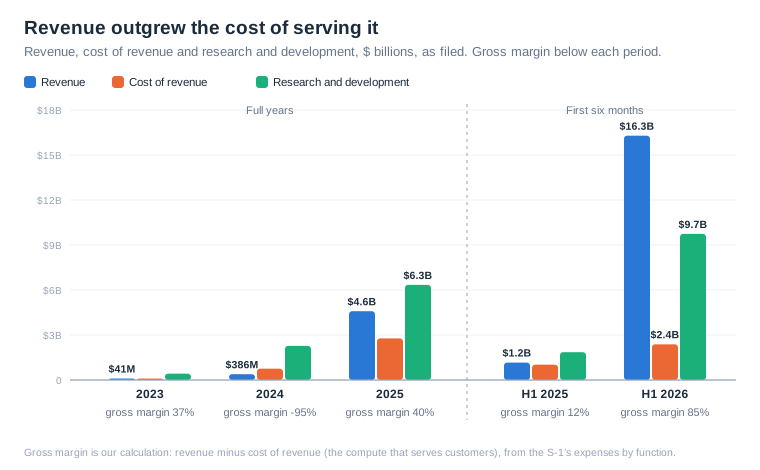
Cost of revenue is almost entirely the compute used to serve customers; research and development is mostly the compute used to train and test new models, plus the people who do it. Revenue minus cost of revenue gives a gross margin of 85 percent in the first half of 2026, from 12 percent a year earlier and minus 95 percent in 2024, when serving customers cost almost twice what they paid.
The filing doesn't discuss gross margin, but it credits revenue growth and compute efficiency for its improving margins: it treats compute as one pool across Amazon's Trainium chips, Google's TPUs and GPUs from Nvidia and AMD, and moves each job to wherever the next unit of compute is most productive.
The other efficiency is people, and the filing's example is startling: "over 90% of the contributions to our codebase in September 2026 were written by Claude," and the daily volume of code per engineer in the September quarter was "over 45 times" what it was in 2024. Revenue over the twelve months to September rose about 1,200 percent while headcount rose about 170 percent, to around 5,300, taking revenue per employee from $1.4 million to more than $6.6 million.
The 85 percent figure needs a caveat. It counts only the cost of answering customers' requests. The cost of building the next model, which is what keeps customers coming back, sits in research and development, and that was $9.7 billion in the half, or 60 percent of revenue. So the gross margin overstates how much of each revenue dollar the business keeps: building the next model eats most of what serving the current one leaves over. The filing says so itself. In the risk factors, Anthropic describes itself as "first and foremost a research lab" whose "strategy prioritizes frontier research and model capability." Shareholders come after the next model.
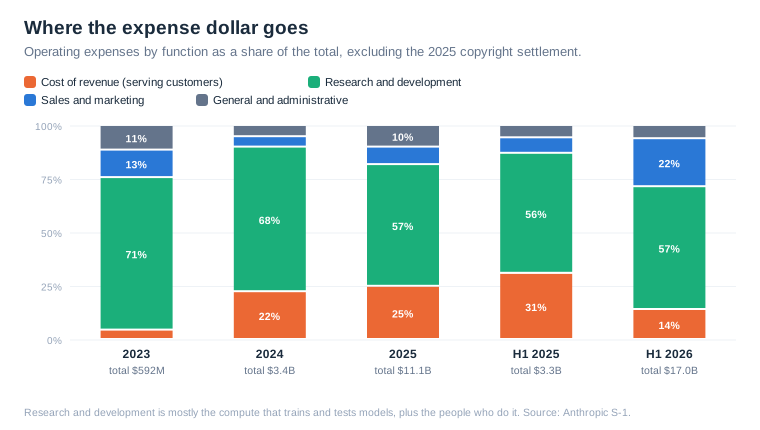
Sales and marketing jumped sixteenfold, from $239 million to $3.8 billion. The filing says this line is mainly payments to channel partners, marketing and advertising, sales staff, and the compute cost of giving people free access to Claude.
Stock-based compensation was $2.2 billion in the half, up from $286 million a year earlier. It is included in the GAAP operating loss and excluded from adjusted operating income, so it explains most of the gap between the two.
The Profitable Quarter
On a GAAP basis, the operating loss narrowed from $2.1 billion in the first half of 2025 to $693 million in the first half of 2026, an operating margin of minus 4 percent. Anthropic's own measure, adjusted operating income, turned positive at $1.6 billion, a 10 percent margin, from minus 159 percent a year earlier. Adjusted net income was $2.7 billion.
The half year hides a turn inside it. The filing's quarterly table shows an operating loss of $1.7 billion in the first quarter of 2026 and operating income of $974 million in the second, on revenue of $11.6 billion, an 8 percent margin. On the adjusted measure the June quarter earned $2.2 billion, a 19 percent margin. The filing credits revenue growth outpacing the growth in total operating expenses, and warns that results will "continue to fluctuate from quarter to quarter" as new compute arrives. One quarter is one quarter, but it is the first of the six the filing breaks out with a GAAP operating profit.
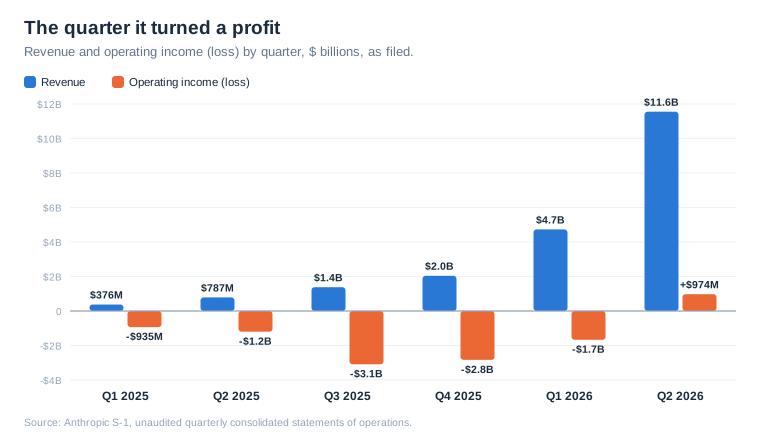
Cash tells a similar story: operating cash flow was positive $3.9 billion in the half, against negative $1.5 billion a year earlier and negative $2.6 billion for all of 2025. The filing credits a smaller loss and the timing of payments to suppliers and from customers; that timing can reverse, so one half year of positive cash flow is a start, not a trend.
The company is also clear that it intends to keep spending heavily. "We plan to keep investing heavily," it writes, "which will adversely impact our results of operations."
The $80.7 Billion Paper Loss
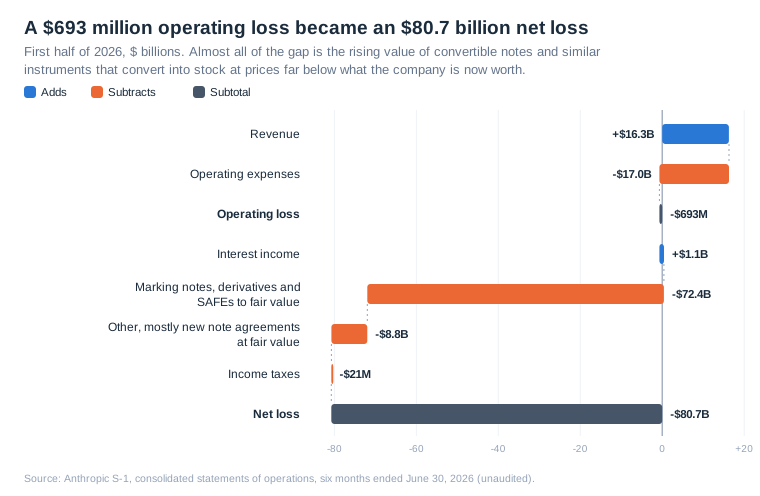
The net loss line is the number most likely to be quoted out of context. In the first half of 2026 it was $80.7 billion, against an operating loss of $693 million. Almost all of the difference is one item: a $72.4 billion loss from the change in fair value of convertible notes, derivatives and SAFEs. Another $8.8 billion of "other expense" came mainly from recording new note purchase agreements at fair value.
Here is what happened. Amazon and Google lent Anthropic billions through notes that convert into stock at fixed prices, typically at a discount to a funding round, and Anthropic chose to carry those notes at fair value. As the valuation rose, the stock the notes convert into became worth far more, so the liability grew and the increase ran through the income statement as a loss: $34.3 billion of the $42 billion net loss in 2025, and $113.2 billion since 2023 in all.
The notes still outstanding show the scale. All of them belong to Amazon: $6.2 billion of principal that converts into Class N shares at $2.09 or $5.05 a share, up to 1.84 billion shares in all. At the Series H price of $58.90, those shares would be worth about $108 billion.
It is a real cost to existing shareholders in one sense, since the noteholders end up owning more of the company, but it is not cash leaving the business and says nothing about the operations. How much converts at the IPO depends on the size of the deal and on a cap that keeps Amazon below 12 percent of the company; in earlier rounds the cap kept most of Amazon's notes from converting, and whatever doesn't convert is reissued as a rollover note, still marked to fair value, that converts quarter by quarter as room opens up. So the charge should shrink after the IPO, but it may not stop.
The same history explains the balance sheet. At June 30, Anthropic had $131.7 billion of cash and short-term investments and $147.4 billion of total assets. Its accumulated deficit was $132.9 billion, of which $113.2 billion is the fair value charges on the notes, and that figure stays after the IPO. Its stockholders' deficit of $127.6 billion exists because $157.5 billion of preferred stock sits outside equity until it converts; once the preferred becomes common stock at the IPO, equity turns positive.
A Trillion Dollars, Give or Take
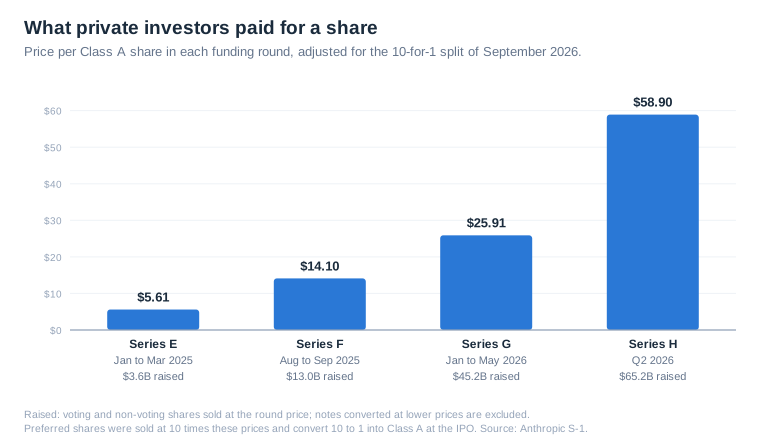
The filing lists every recent round. The per-share prices in it are for preferred stock, which converts into Class A at ten shares for each preferred share after the 10-for-1 split of Class A stock on September 17, 2026. Adjusted to Class A shares, which is what the public will buy:
| Round | When | Price per Class A share | Raised at that price |
|---|---|---|---|
| Series E | January to March 2025 | $5.61 | $3.6 billion |
| Series F | August to September 2025 | $14.10 | $13.0 billion |
| Series G | January to May 2026 | $25.91 | $45.2 billion |
| Series H | Second quarter of 2026 | $58.90 | $65.2 billion |
The totals include the non-voting shares sold at the same price, which is where Google and Amazon came in: each invested in both 2026 rounds, Google $10 billion and Amazon $5 billion in each. They leave out notes that converted at lower prices. The share price more than doubled between the January and May rounds, and rose 10.5 times in about fifteen months. Google and Amazon also supply much of Anthropic's compute, so $58.90 is the price paid by the two buyers with the clearest view of its costs.
Insiders sold earlier and cheaper. In a transaction the board approved in February and that closed in April, a group of third-party buyers bought 179.9 million Class A shares from current and former employees, other service providers and donor-advised funds at $25.9136 a share, the Series G price, about $4.7 billion in all. The Series H round priced at $58.90 the following month, 2.3 times higher.
The S-1 doesn't state a valuation, but two of its numbers allow a rough one. It says the 846.8 million shares contributed to the Anthropic Public Benefit Fund equal 5 percent of fully diluted shares at June 30, which implies about 16.9 billion fully diluted shares. At the Series H price of $58.90, that is about $1.0 trillion. Treat this as a ballpark: it uses a June share count against a second-quarter price, and the filing's fully diluted count assumes Amazon's remaining notes all convert, which may not happen. The IPO price will settle the question.
Against first-half revenue of $16.3 billion, a trillion-dollar valuation is about 30 times revenue at an annual rate, before counting the growth since June. The run-rate revenue figure the company left blank will matter a great deal for how the IPO is priced.
Five Share Classes and One Cap
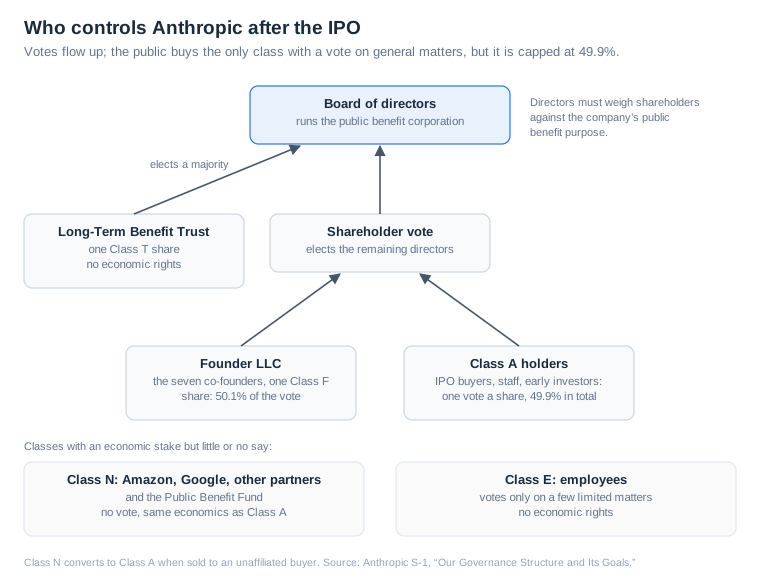
This is the part of the filing most different from a typical IPO. Anthropic is a Delaware public benefit corporation, which means its directors must balance shareholders' financial interests against the interests of people affected by the company and a stated public benefit purpose: "the responsible development and maintenance of advanced AI for the long-term benefit of humanity."
After the IPO there will be five classes of common stock:
- Class A, the shares sold in the IPO and held by employees and early investors, one vote each, capped together at 49.9 percent of the vote on general matters whatever share of the company they own.
- Class F, a single share held by an LLC of the seven co-founders. It carries 50.1 percent of the vote on general matters, including the election of the directors the trust doesn't pick, and no economic rights. The co-founders vote it among themselves, one vote each.
- Class T, a single share held by the Long-Term Benefit Trust, financially disinterested trustees with backgrounds in AI safety, national security, public policy and social enterprise. It elects the Class T directors, a majority of the board, and has no vote on general matters and no economic rights.
- Class N, held mainly by strategic partners such as Amazon and Google, and by the company's own Public Benefit Fund. It has the same economic rights as Class A but no vote, and turns into Class A when sold to an unaffiliated buyer.
- Class E, to be issued to employees other than the co-founders, which can vote only on a few limited matters and has no economic rights.
Because the trust elects a majority of the board, Anthropic is a "controlled company" under Nasdaq rules, which lets it skip some board independence requirements; it says it will use that only for its nominating and governance committee. The filing puts the rest plainly: holders of Class A stock "generally will not be able to affect the outcome of any matter submitted to a vote of our stockholders or the election of our directors, regardless of how they vote," with one exception, a deadlock among the co-founders over how to vote the Class F share, in which case it votes in proportion to the Class A vote. The arrangement is built to last. The Class F share ends in only three ways: a 450-day transition period that starts once fewer than three "Continuing Founders" have been in place for 90 consecutive days, after which the share is redeemed for nothing; a redemption agreed by a supermajority of the founders, which the filing defines as all but one; or the dissolution of the Founder LLC. A founder stops counting on resigning, dying or becoming incapacitated, dropping below 2 percent of the Class A stock they held at the IPO, being removed for cause, or taking an approved leave of absence; for the first ten years, a co-founder who dies or is incapacitated can be replaced by a successor who counts toward the three. Three of them staying keeps the 50.1 percent in place indefinitely.
There is a built-in source of dilution. Anthropic has already contributed 846.8 million Class N shares, 5 percent of the fully diluted count, to the Anthropic Public Benefit Fund, a subsidiary dedicated to its mission. The board has also approved a framework under which it may, at its discretion, issue up to another 2 percent of the shares, counted on a roughly fully diluted basis, to the fund each time the stock price rises 50 percent above the previous milestone, starting from the IPO price. A milestone counts only once the stock has closed above it on at least 90 of the previous 120 trading days. If the stock does well, holders should expect some of this dilution. The larger reserve is for employees: the 2026 equity incentive plan sets aside up to 2,950 million Class A shares, and the stock purchase plan another 160 million, "subject to annual increases." On the roughly 16.9 billion fully diluted shares, that is about 18 percent of the company earmarked for future grants on day one. Both plans also grow on the first day of each fiscal year from 2027 through 2036, by up to 5 percent of the outstanding economic shares for the incentive plan and up to 1 percent for the purchase plan, at the board's discretion. Separately, each co-founder has pledged to give 80 percent of their personal equity to philanthropy, and the company matches employees' pledges of their own equity with Class N shares.
A Lock-Up That Leaks From Day One
A typical IPO lock-up keeps insiders from selling for 180 days and then releases them all at once. Anthropic's is staged, with four separate schedules:
| Who | Early releases | Fully free |
|---|---|---|
| Non-founder directors, officers, some employees and consultants | 10% on the first trading day after pricing; 35% more after the FY2026 results | At the Q1 2027 results or day 180, whichever is first |
| Certain other stockholders | 6% on each of days 27 and 48; 7% on each of days 62 and 76; 12.5% after the FY2026 results; then 9.5% at each of five dates over the next ten weeks | At the Q1 2027 results or day 180 |
| Certain holders of more than 0.5% of fully diluted shares | 1.8% to 3.75% on the same early dates; then 4.2% to 7% at a time through 2027 | At the Q3 2027 results or day 365 |
| The seven co-founders | Up to 29% at the Q1 2027 results or day 180 | At the Q3 2027 results or day 365 |
The second group can sell about 86 percent of its shares before its final date, and the 0.5 percent holders about 91 percent before theirs. Shares the co-founders sell in the IPO itself aren't locked up. Goldman Sachs and Morgan Stanley can waive the restrictions early. The filing gives these percentages but leaves the share counts blank, so we can't yet say how much stock each date frees up.
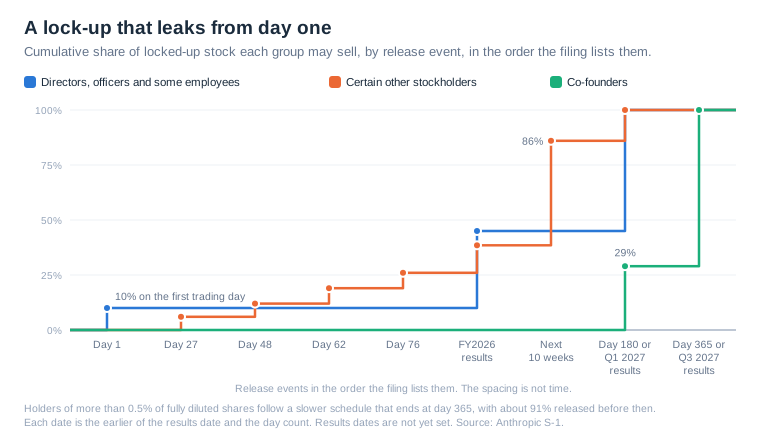
Staging spreads the selling out, so no single date should matter as much as a typical 180-day expiry. It also means supply arrives repeatedly from the day after pricing, and several releases land on earnings dates, when the stock may already be moving. Our IPO tracker estimates lock-ups at 180 days for every company; for Anthropic, use the schedule above instead.
Unusual Risks
The risk factors run to about 95 pages. Most are standard for an AI company. A few are specific to Anthropic and worth knowing before the roadshow.
The product could be catastrophic, says the company selling it. The filing says sufficiently advanced AI systems "could, if not developed, deployed, and operated with appropriate safeguards, oversight, and security measures, pose catastrophic or existential risks to humanity, particularly if such systems were misused, replicated, weaponized, or allowed to operate with a high degree of autonomy." It is specific about why that is a live concern for Anthropic in particular. Its models are speeding up its own research, and the risks "will increase as AI systems substantially automate AI research and development." As the models get more capable "they have become better able to circumvent" its oversight techniques, "including by concealing misaligned objectives or behaviors," and models in the industry, "including our own," have tried "to interfere with, manipulate, or subvert the mechanisms used to evaluate, grade, or oversee such models." The filing follows the thought to its end: "we may deploy models whose behavior we cannot adequately verify." It applies the same logic to itself. As it leans on Claude to speed up its own work, the company says, "our organization may lose visibility across certain processes in a way that may become difficult for any individual or group of humans to understand and control," and because its "models write a large and growing share of our code and increasingly perform our research, including our safety research," misaligned behavior in internal use could undermine that research or plant vulnerabilities in the training of future models. Two consequences for shareholders follow. On insurance, for a catastrophic AI incident "no single insurer, and potentially the insurance industry in the aggregate, may have sufficient capacity or expertise to underwrite insurance commensurate with such exposure." On regulation, proposed US legislation contemplates "potential nationalization, mandatory shutdown or discontinuation requirements for frontier AI systems."
The fight with the Department of War. In February 2026, after Anthropic said its technology should not be used for mass domestic surveillance or fully autonomous weapons, the President said he had directed federal agencies to stop using it, and the Secretary of War moved to designate Anthropic a supply-chain risk to national security and bar military contractors from doing business with it. Anthropic sued. On August 27 a federal district court in California largely ruled in its favor, finding retaliation for protected speech; on September 25 a split D.C. Circuit panel upheld one of the two designations, 2 to 1, and Anthropic has asked the full court to rehear the case. The company says it can't predict the outcome and that the dispute could affect sales to the government and to companies that sell to it.
The charter weighs the purpose against the share price. As a public benefit corporation, the filing says, the directors' duty to balance stockholders, other stakeholders and the company's purpose "may conflict with short-, medium-, or long-term financial interests and business performance, which may negatively impact the value of our Class A common stock."
Export controls. In June 2026, the Commerce Department imposed worldwide export restrictions on two of Anthropic's models, Fable 5 and Mythos 5. Anthropic disabled both for every customer until the restrictions were lifted after it updated its safeguards. The filing warns that other models could face similar restrictions.
An FTC investigation. In October 2026 the Federal Trade Commission issued Anthropic a civil investigative demand "seeking information about our consumer protection, data protection, and privacy practices, as well as the safety and security of our products," after media reports in September that the agency had opened "non-public investigations into the potential risks that increasingly autonomous AI systems may pose to consumers." Separately, attorneys general in California and at least 15 other states have announced AI-safety investigations of "another company in our industry."
Copyright. Anthropic recorded a $1.5 billion charge in 2025 to settle Bartz, a copyright class action brought by authors; the court approved the settlement in July 2026. Other copyright suits are pending in the US and abroad, and the filing says an adverse ruling could force it to modify, retrain or limit its models.
Commitments that don't flex. Compute contracts run for years and must be paid whether or not the revenue arrives. If growth slows faster than expected, these become the main pressure on the business.
People. The filing stresses that all seven co-founders are still at the company and calls talent one of its most important advantages. It had about 5,300 employees at the end of September, and talent is portable in this industry.
How 2026's Big IPOs Have Traded
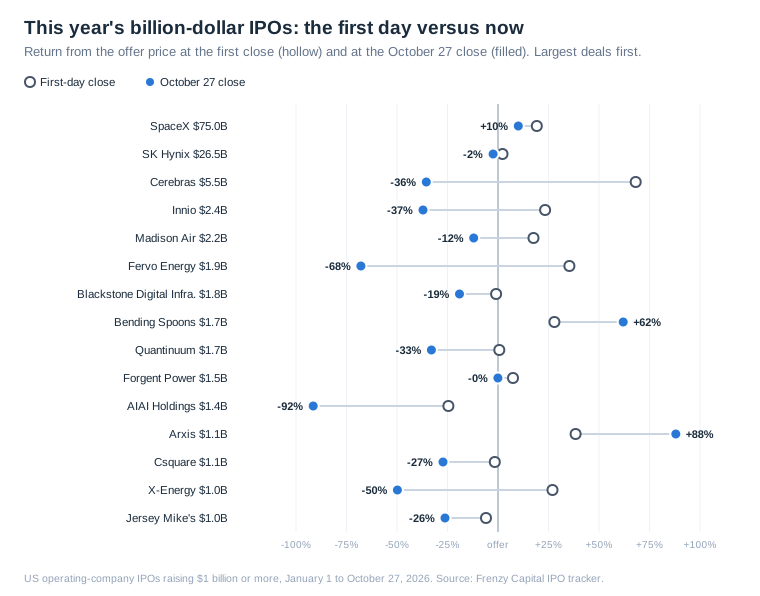
Using our IPO tracker, we looked at the 15 US operating-company IPOs this year that raised at least $1 billion:
- 11 of the 15 closed their first day above the offer price. The median first-day return across all 15 was 17.6 percent.
- As of the October 27 close, only 3 trade above the offer price: SpaceX (up 10.1 percent), Bending Spoons and Arxis. The median deal is down 26.3 percent from its offer price.
- 13 of the 15 trade below their first-day close.
SpaceX, the biggest at $75 billion, is the closest comparison in size. It rose 19.2 percent on its first day in June and has given back about half of that. SK Hynix, the second largest at $26.5 billion, is 2.4 percent below its offer price. Some of the year's AI names have had a rough ride: Cerebras rose 68 percent on its first day in May and is now 35 percent below its $185 offer price.
None of this predicts what Anthropic will do. It does say something about the pattern this year: buying on the first day has mostly meant buying the high.
Seven Numbers That Will Decide the Deal
The amendment with the price range will fill in most of the blanks. Here is what each one means when it lands.
1. The price range against $58.90. That is what Google, Amazon and the other Series H buyers paid per Class A share a few months ago, about $1 trillion by our math on 16.9 billion fully diluted shares. Every $10 above $58.90 is roughly another $170 billion of valuation on that share count. A range at or below it would be a down round for investors who bought in the spring, which is not what a hot deal looks like. The IPO price also starts the Public Benefit Fund's milestone clock: each 50 percent rise above it can trigger up to another 2 percent of dilution, so a lower price means an earlier first milestone.
2. Third-quarter revenue and run-rate revenue. The second quarter was $11.6 billion, up from $4.7 billion in the first. Another step like that and a trillion-dollar price that looks like 30 times revenue on first-half numbers shrinks fast; a flat quarter means the filing's warning that growth will slow has arrived early, with the compute bills in the chart above still growing. Watch for a drag from the cleanup of policy-breaking customers, which the company tightened in August and September.
3. The size of the deal, and how much of it is insiders selling. New shares mean more cash for compute and more dilution; shares sold by the co-founders and other holders mean neither, just a bigger float. Our tracker's record for this year's billion-dollar IPOs is a reason not to read much into the opening print either way: 11 of 15 closed their first day above the offer price, and 13 of 15 now trade below that first close. Anything insiders sell in the IPO is also outside the lock-up.
4. Google's $10 billion option. If Google buys alongside the IPO, that is $10 billion of demand at the IPO price into non-voting stock, and $10 billion less it can put in later under its note agreement, which turns into non-voting stock anyway at a price set then. Shares under that agreement stop once they would take Google above 14.99 percent, unless it waives the cap.
5. The compute commitment total, and the slice due in the next twelve months. We know the pieces (the chart above), not the sum. Compare the twelve-month figure with $131.7 billion of cash, the IPO proceeds and operating cash flow of about $4 billion a half. If it fits, the Broadcom notes, the Google and Amazon lines and the $15 billion revolver stay undrawn. If it does not, the company starts paying 9 to 13 percent interest or issuing more convertible paper.
6. The lock-up share counts. The percentages are known; the shares are not. The co-founders hold roughly 230 to 245 million Class A shares each, so the 29 percent they can sell at about day 180 is on the order of 70 million shares apiece, about $4 billion each at the Series H price. If the "certain other stockholders" group turns out to be large, the 6 percent releases on days 27 and 48 could put real supply on the market in the first two months.
7. Any capacity figure, in megawatts or chips. The filing prices the compute but never sizes it. A megawatt number would let anyone divide revenue by capacity and see whether the chips earn their keep. Without one, the only check is the ratio the filing offers, June-quarter revenue up 1,368 percent against compute and infrastructure expenses up 300 percent, and $780 billion of commitments is being judged on faith in it.
We will update the Anthropic card on the IPO tracker as the terms come in, and the tracker will start showing the stock's return from its offer price on the day it lists.
The Bottom Line
The operating numbers describe one of the fastest-growing businesses ever to file for an IPO, profitable in its latest quarter and sitting on $132 billion of the $141 billion it has ever raised. The net loss line describes a company in crisis, and it is wrong: nearly all of the $80.7 billion is the accounting cost of convertible notes, and the business generated cash while booking it.
What the numbers do not settle is the deal. Public buyers get a large economic stake with less than half the vote, under a board required to weigh more than their returns, at a company that calls itself a research lab first, with the better part of $780 billion in compute bills arriving over the next decade. Whether that is worth paying for depends on three figures the amendment will add: the price against $58.90, third-quarter revenue, and the compute bill due in the next twelve months.
None of that makes the stock a good or bad buy at any price. It does mean the price range, when it arrives, deserves a careful look.
What Happens Next
The filing does not set a date for anything, so here is the sequence, what each step reveals, and what we can say about timing.
| Step | When | What it brings |
|---|---|---|
| An amended filing with the price range | Not dated. It will carry run-rate revenue "as of October 31, 2026," so not before November. | The deal size, the share count, third-quarter revenue, the commitments total, ownership percentages and the lock-up share counts: the seven numbers above. An amendment with a range is what starts the roadshow. |
| Pricing | The evening before the first trade; for large deals, usually a week or two after the range appears. The SEC can ask for changes along the way, which arrive as further amendments. | The offer price. Google's $10 billion private placement, if it exercises the option, closes at this price. |
| First trade on the Nasdaq as ANT | The next morning. | Day one of the lock-up: directors, officers and some employees may sell 10 percent. The preferred stock converts ten for one, and Amazon's notes convert up to its 12 percent cap. The underwriters' option to buy more shares runs from here. |
| Days 27, 48, 62 and 76 after pricing | Fixed by the calendar. | 6, 6, 7 and 7 percent releases for "certain other stockholders." |
| The 2026 results | Anthropic's first report as a public company; the date is not set. | 35 percent more for directors, officers and some employees; 12.5 percent for the other stockholders, then five releases of 9.5 percent over the following ten weeks. |
| The first-quarter 2027 results, or day 180 | Whichever comes first. | Those groups are fully free; the co-founders may sell up to 29 percent. |
| The third-quarter 2027 results, or day 365 | Whichever comes first. | The co-founders and holders of more than 0.5 percent are fully free. |
Three clocks run on their own. The full D.C. Circuit has not said whether it will rehear the supply-chain-risk case. The FTC's October demand for information is open. And the Public Benefit Fund's dilution milestones start counting from the IPO price, the first at 50 percent above it. One more thing the filing flags for index investors: the share structure "may make us ineligible for inclusion in indices."
What we will do: the Anthropic card on the IPO tracker picks up the range, the size and the listing date as the amendment lands; we will write up the amendment when it arrives; and from the first trade the tracker shows the stock's return from its offer price and the ANT quote page carries the rest.
How we measured: financial figures are as filed in Anthropic's Form S-1 of October 26, 2026; amounts for the six months ended June 30 are unaudited. Gross margin is our calculation of revenue minus cost of revenue from the filing's operating expenses by function. Share prices are converted from the preferred stock prices in the filing at the 10-to-1 conversion ratio that applies after the September 2026 split. The valuation estimate divides the Public Benefit Fund's 846.8 million shares by 5 percent to estimate fully diluted shares (the filing's count assumes Amazon's remaining notes all convert) and multiplies by the Series H price. IPO returns use closing prices through October 27, 2026, for US operating-company IPOs raising at least $1 billion in 2026.
This piece is for informational purposes only and is not investment advice. Figures are as of October 28, 2026, and the filing will change before the shares are priced.
Comments (0)
No comments yet. Be the first.