Binary Options Paying $100 or Nothing Now Trade on NVDA, TSLA, SPY, IWM and IBIT
NYSE American Options began listing Binary Return Options on SPY on October 29, 2026, and added IBIT, IWM, NVDA and TSLA on November 5. Each contract pays a fixed $100 if the underlying closes on the right side of its strike on expiration day, and nothing if it doesn't. On November 12 the five carried 864 of these contracts between them.
The exchange's product overview names seven more underlyings for the launch: AAPL, AMZN, ORCL, SPCX, GLD, SLV and TLT. None of those had started trading by November 12: the exchange had posted no notice for them, and none appeared in our option data.
Because the payout is fixed, a binary's price reads directly as the market's odds. We compared those odds with what the much larger market in regular options implied for the same strikes and dates.
The Short Version
- A binary call pays $100 if the stock closes at or above the strike, a binary put pays $100 if it closes below, and either pays nothing otherwise. They settle in cash on the closing price from the underlying's primary listing market, and there is no early exercise.
- The price is a probability. At 12:10 p.m. ET on November 12, NVDA's December 11 binary call at $165 was 45 cents bid and 49 cents offered: the market put the chance of an NVDA close above $165 that day at about 47 percent.
- Binary prices track regular options closely a week or more out. Averaged across strikes, binary calls sat 0.4 points below the probability implied by regular options on NVDA, 0.7 on TSLA, 1.0 on IWM, 1.5 on IBIT and 2.2 on SPY.
- One day from expiry they did not. On NVDA and TSLA, the binaries expiring November 13 priced about half the volatility that regular options did, and their odds differed from the regular options' by up to 20 points. SPY's agreed.
- The textbook N(d2) formula ran lower, by 3.1 points on TSLA, 3.8 on IWM and 7.1 on SPY on average, and by up to 11 points on single SPY strikes, because it leaves out the volatility skew.
- Trading is small so far. By our count 2,405 binary contracts traded on November 9, 2,263 of them on NVDA, against 24.8 million regular options on the same five names. Open interest was 483 contracts on November 12.
- The typical quote was 4 cents wide. That is a small cost on a 47 cent contract and a large one on a 10 cent long shot.
How the Contracts Work
The exchange calls them Binary Return Options, or ByRDs, short for Binary Return Derivatives, their name in the rulebook. A call is a "Finish High" and a put a "Finish Low". The terms below come from NYSE American's product overview and its October 2026 rule filings.
| Term | What the exchange's documents say |
|---|---|
| Payout | $100 if the underlying finishes on the right side of the strike, $0 otherwise |
| Finish High (call) | Pays if the underlying closes at or above the strike |
| Finish Low (put) | Pays if the underlying closes below the strike |
| Settlement price | The closing price reported by the underlying's primary listing market |
| Exercise | European style, exercised automatically at expiration; the holder makes no exercise decision |
| Expirations | Five consecutive weekly series at a time, normally expiring on Fridays, with a new series added each Thursday |
| Prices | Quoted in pennies; orders above $1.02 are rejected |
| Market makers | Quotes no wider than $0.25 ($0.50 on expiration day); market makers are not required to quote |
| Hours | 9:30 a.m. to 4:00 p.m. ET, to 4:15 p.m. for some underlyings; no FLEX or complex orders |
| Position limit | 25,000 contracts on the same side of the market for each underlying |
| Exchange fee | $0.00 a contract for customers, $0.50 for broker-dealers |
Prices are quoted per $1 of payout, so a 47 cent quote costs $47 for a contract that pays $100. A seller of that contract collects $47 and owes $100 if it finishes in the money.
The relaunch changed two things from the version NYSE listed in 2016. Settlement moved from a volume-weighted average of the whole day's prices to the closing price. And a stock now needs a market value of at least $290 billion and at least $10 million a day traded in its closing auction to qualify. The exchange estimated that about 100 securities pass, against 305 without the new tests. Its filing says the auction minimum is there so that moving the closing price would take substantial money, in plain view of the market.
A Price Is a Probability
A regular call pays more the further the stock finishes above the strike, so its price mixes the chance of finishing above with how far above. A binary call only asks whether, so its price, out of $1, is the market's odds.
At 12:10 p.m. ET on November 12, with NVDA at $164.30:
| December 11 contract, $165 strike | Bid | Ask | Pays at expiration |
|---|---|---|---|
| Binary call (Finish High) | $0.45 | $0.49 | $100 if NVDA closes at or above $165 |
| Binary put (Finish Low) | $0.51 | $0.55 | $100 if NVDA closes below $165 |
| Regular call | $11.10 | $11.35 | $100 for every dollar NVDA finishes above $165 |
The binary call's midpoint of 47 cents puts the chance of an NVDA close at or above $165 on December 11 at about 47 percent. The binary put asks the same question from the other side, so the two midpoints add up to $1. Across all 864 contracts, the call and put midpoints at each strike added up to between 99 cents and $1.01.
Strictly, a binary price is a market price, not a forecast. It includes whatever traders charge for taking the risk, and a dollar paid in December is worth slightly less than a dollar today. Over a few weeks the second effect is well under a point.
What Regular Options Already Said
The same odds can be read from regular options, and that tells us whether the new contracts are priced in line with the market beside them. A call spread that buys NVDA's December 11 $160 call and sells the $170 call pays $10 if NVDA finishes above $170, nothing below $160, and a ramp in between. Its price per $1 of width, 46.8 cents at midpoints, is very close to the price of a binary call at $165. This is the textbook way to copy a binary with ordinary options.
The common shortcut is a formula: N(d2) from the Black-Scholes model, fed the regular option's implied volatility at that strike. Some trading platforms show it, or an option's delta, as the probability of finishing in the money.
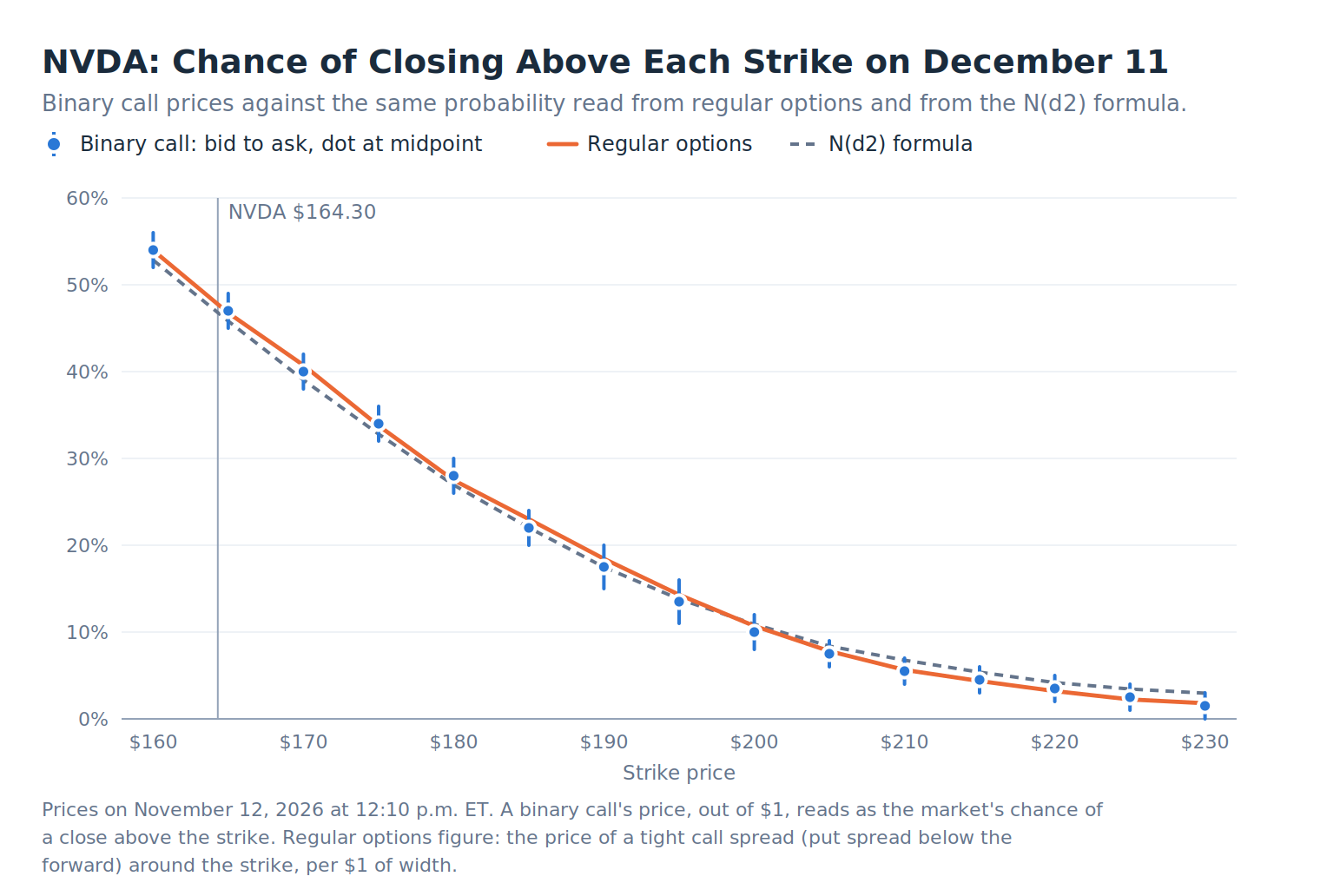
For NVDA, all three agree to within about 2 points. The $165 binary call was 47 cents, the call spread said 46.8 percent and N(d2) said 45.8 percent. Note where NVDA's strikes sit: the ladder runs from $160 to $230 for every expiration, and with NVDA at $164.30, 14 of the 15 strikes were above the stock.
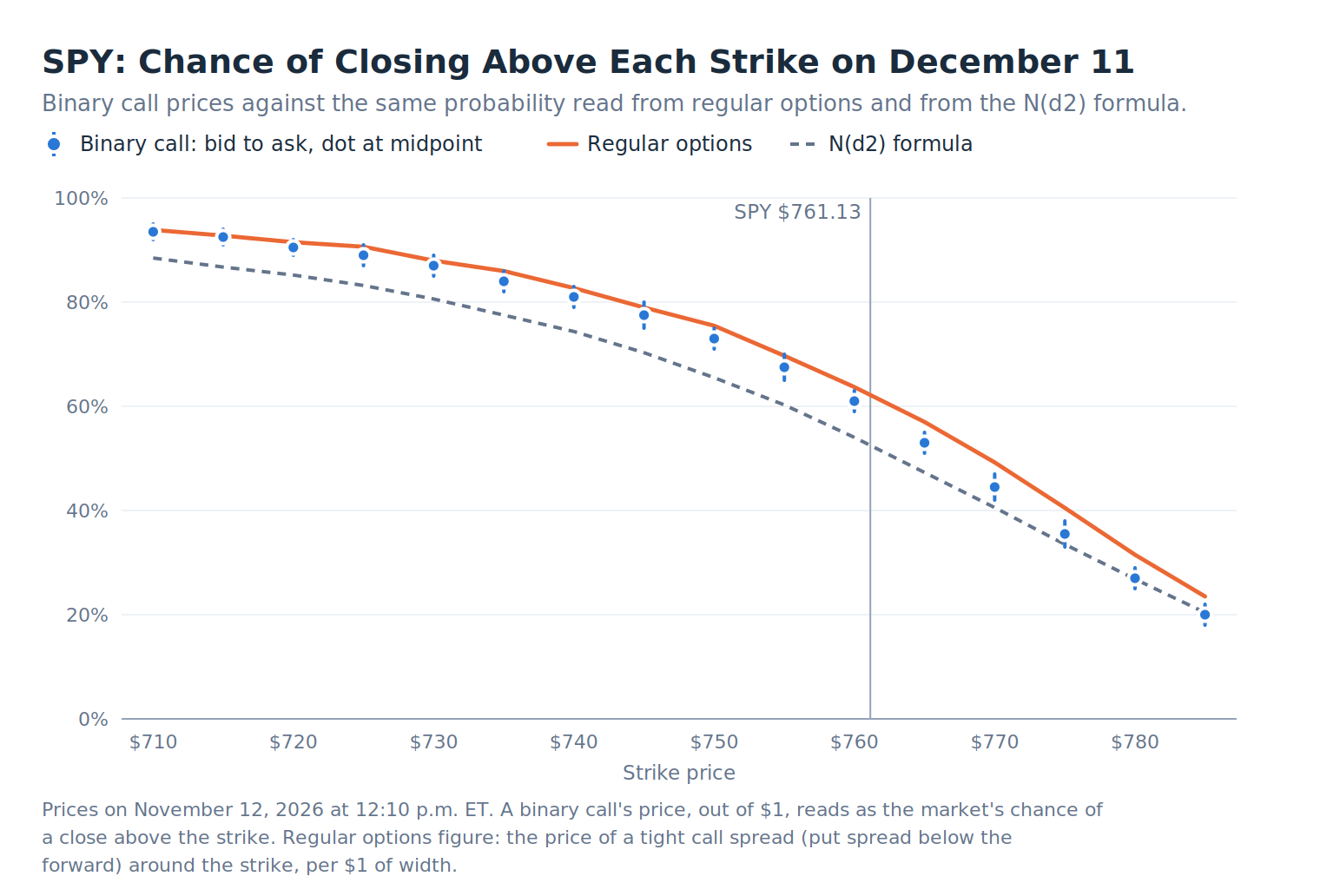
SPY is different. On the December 11 contracts, N(d2) sat 9.7 points below the regular options figure at the $760 strike, and binary calls sat in between, 3.5 to 5 points under the regular options figure on every strike above the price. The N(d2) gap comes from skew. SPY's lower strikes carry higher implied volatility than its upper strikes, and that slope makes a tight call spread worth more than the formula says when it uses a single strike's volatility. The slope is steep on an index fund, so the gap is large.
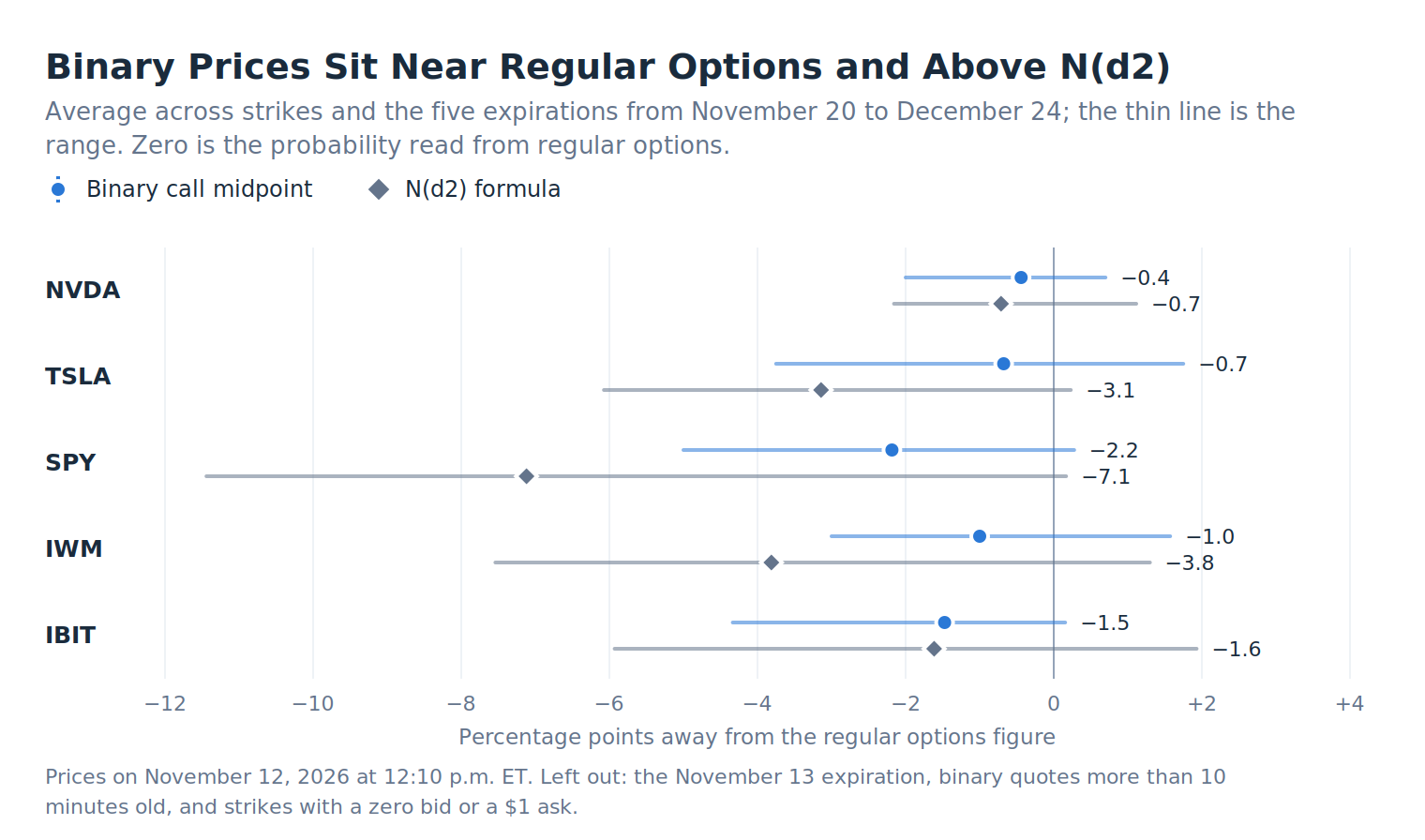
| Underlying | Strikes compared | Binary call vs regular options | Binary within 2 points | N(d2) vs regular options |
|---|---|---|---|---|
| NVDA | 48 | 0.4 points lower | 100% | 0.7 points lower |
| TSLA | 85 | 0.7 points lower | 92% | 3.1 points lower |
| SPY | 58 | 2.2 points lower | 50% | 7.1 points lower |
| IWM | 43 | 1.0 point lower | 81% | 3.8 points lower |
| IBIT | 30 | 1.5 points lower | 80% | 1.6 points lower |
Two things stand out. Binary prices track regular options on all five, which is what you would expect if the firms quoting binaries hedge them with regular options. And N(d2) runs low on TSLA, SPY and IWM, by 3 to 7 points on average. Anyone who reads N(d2), or delta, as the chance of finishing above a strike on those names gets a number that is too low. A binary price states that chance directly.
One Day From Expiry
The agreement broke down on the contracts expiring the next day, November 13. These were live quotes, updated within a minute of the snapshot.
| NVDA, November 13 contract | Binary call bid and ask | Chance from the binary | Chance from regular options |
|---|---|---|---|
| $160 strike | $0.86 / $0.90 | 88% | 69.5% |
| $165 strike | $0.41 / $0.46 | 43.5% | 47.2% |
| $170 strike | $0.05 / $0.08 | 6.5% | 26.4% |
The binaries put much more weight on NVDA finishing near $164.30 than regular options did. Run through the same formula, the binary prices imply NVDA moving with a volatility of about 40 percent over that last day, against about 90 percent in the regular options. TSLA's one-day binaries showed the same pattern, about 22 percent against 44 percent: its $395 binary call was 21.5 cents, against 36.6 percent from regular options. SPY's one-day binaries agreed with its regular options to within 3 points. The comparisons in the previous section leave the one-day contracts out for this reason.
Small So Far
Trading has been light. By our count, 2,405 binary contracts traded on November 9 across the five names, 2,263 of them on NVDA, against 24.8 million regular options on the same five. On November 10 and 11 it was 151 and 123. Open interest was 483 contracts on November 12, 427 of them on NVDA.
Quotes were steady even so. The median binary was 4 cents wide on every underlying, well inside the exchange's 25 cent maximum.
What It Means for Retail Traders
- The risk is fixed in advance. A buyer can lose only what they paid and can make at most $100 minus that. There are no shares to deliver and no early assignment. A seller's worst case is $100 minus the premium collected.
- The bid-ask spread costs more on long shots. The spread is a few cents whatever the price. On NVDA's December 11 $165 binary, buying at 49 cents and selling straight back at 45 loses about 8 percent of what was paid. On the $200 binary, quoted 8 and 12 cents, the same round trip loses a third.
- The quote is the market's odds, not a forecast. On November 12, for expirations a week or more out, binary prices sat close to what the regular options beside them implied, so they offered no discount on the odds the larger market was already pricing. The one-day NVDA and TSLA contracts were the exception, and on those the two markets gave very different odds for the same close. SPY's binary calls ran a few points under the regular options figure, and its binary puts, the other side of the same question, a few points over it.
- Liquidity depends on market makers who are not required to quote. With open interest in the hundreds, getting out before expiration means trading with them.
- These are not the binary options of the old investor warnings. In 2013 the SEC and the CFTC warned investors about binary options sold on unregistered platforms. These contracts are listed on a US exchange and cleared by the Options Clearing Corporation, and brokers must give options customers the options disclosure document, to which the SEC approved a supplement covering binary options on stocks in 2008.
- The payoff is the same yes or no shape that prediction markets sell. Polymarket, for example, runs daily markets on whether NVDA closes up or down from the day before. The difference is the wrapper: these trade in an options account, under options rules, with options approval.
Tried Before
Exchange-listed binaries on single stocks are not new. The SEC approved them as Fixed Return Options in 2007 and approved the name Binary Return Derivatives in 2014. NYSE launched ByRDs on 15 stocks and exchange-traded products in April 2016. The 2026 version keeps the name and changes the settlement price and the listing standards.
Other exchanges are trying the same idea on indexes. Cboe launched binary options on its Mini-S&P 500 Index (XSP) on June 23, 2026, under the Cboe Predicts name. They also pay $100 or nothing, and Interactive Brokers offered them at launch.
Where They Trade
NYSE American lists them under its own rules, and every binary quote in our data came from that one exchange. On November 11, moomoo, the US brokerage owned by Futu Holdings, said it plans to offer them to US retail investors. As of November 12 we found no other US broker that had said publicly it carries the NYSE contracts.
How We Measured
Prices are from our own option chain snapshot at 12:10 p.m. ET on November 12, 2026, when 863 of the 864 binaries on the five underlyings had a live quote. We used bid-ask midpoints. For each binary strike, the regular options figure is the price of a tight vertical spread around the strike, per $1 of width, from midpoints: calls for strikes at or above the forward price, and one minus the matching put spread below it. N(d2) uses the implied volatility of the regular out-of-the-money option at the strike, a forward price from put-call parity at the strike nearest the stock, and time to the 4 p.m. close on expiration day. The comparisons for a week or more out leave out the November 13 expiration, which is shown on its own, binary quotes more than 10 minutes old at the snapshot, and strikes with a zero bid or a $1 ask. The volatilities in the one-day section solve N(d2) for the volatility that gives each price. Volumes and open interest are from the same daily snapshots, counted by trade date.
Sources
- NYSE American Options, Binary Return Options: Product Overview, October 2026
- NYSE trader updates: SPY Binary Return Options Available October 29 (October 28, 2026) and IBIT, IWM, NVDA, TSLA Binary Return Options Available November 5 (November 4, 2026)
- SEC, Release No. 34-106743, SR-NYSEAMER-2026-96, and its rule text; Federal Register notice, October 30, 2026
- NYSE American, SR-NYSEAMER-2026-99, fees for Binary Return Options
- Moomoo, Moomoo joins NYSE to debut Binary Return Options, November 11, 2026
- Cboe, Cboe Introduces Cboe Predicts, June 23, 2026
- ICE, NYSE Amex Options launches Binary Return Derivatives, April 19, 2016
- SEC, SEC and CFTC investor alert on binary options, June 6, 2013
- FINRA, June 2008 Supplement to the Options Disclosure Document, August 26, 2008
- Polymarket, example daily NVDA up or down market
Data: Frenzy Capital. Prices are as of 12:10 p.m. ET on November 12, 2026. This post is for information only and is not investment advice.
Comments (0)
No comments yet. Be the first.