Anthropic Sets Its IPO Range at $70 to $78 a Share
Anthropic filed the second amendment to its IPO registration statement on November 10 and started its roadshow the same day. This is the amendment our last piece was waiting for: it fills in the price range, the share count, run-rate revenue and the lock-up share counts. The company's IPO website, filed with the SEC as a free writing prospectus, says the price is expected to be set on November 18 and the shares to start trading on Nasdaq as ANT on November 19, subject to regulatory clearance.
Press reports on November 9 put the range at $70 to $80; the range on file is $70 to $78. The Anthropic card on our IPO tracker carries the filed terms and will switch to the offer price and the return once the stock trades.
The Short Version
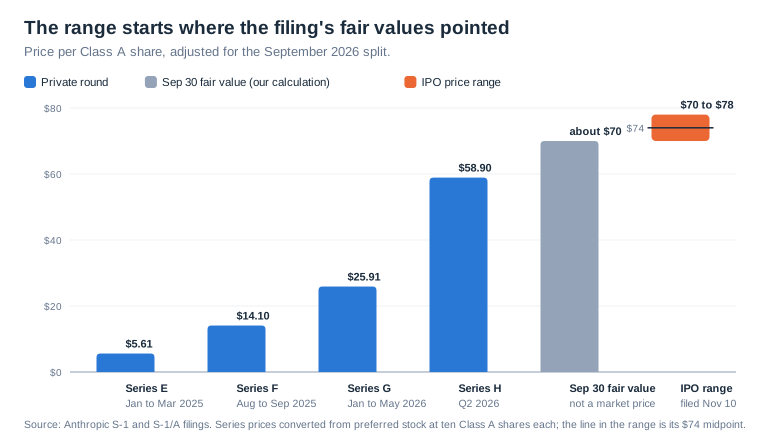
- The range is $70 to $78 a share, 19 to 32 percent above the $58.90 that Series H investors paid in the second quarter. It starts right at the roughly $70 that the filing's own September 30 fair values pointed to.
- 825 million shares raise $57.75 billion to $64.35 billion. Anthropic sells 801.4 million new shares, and the seven co-founders sell 3.4 million each. The underwriters can buy 123.75 million more, which would take the deal to $74.0 billion at the top. Only SpaceX's $75.0 billion in June has been larger.
- Seven partners add $26.0 billion in a private placement at the IPO price: Google and NVIDIA $10 billion each, AMD $2.5 billion, Broadcom, Micron and Microsoft $1 billion each, and TSMC $500 million.
- About $1 trillion. On the 13.09 billion shares outstanding after the offering, the range is worth $916 billion to $1.02 trillion. On the filing's own fully diluted count of 18.0 billion shares, it is $1.26 trillion to $1.41 trillion.
- Run-rate revenue was about $81 billion on October 31, up $10 billion from September 30.
- Up to 20 percent of the shares may go to retail investors, in the US and abroad.
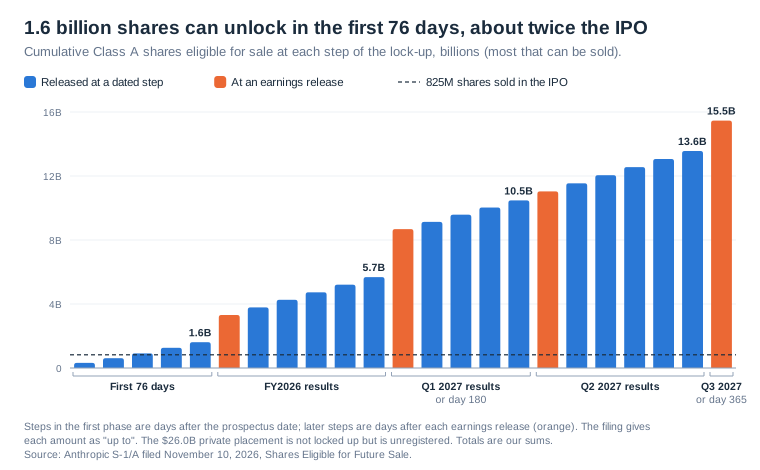
- Up to 316 million shares can be sold on the first day of trading and up to 1.6 billion in the first 76 days, against 825 million sold in the IPO. About 15.5 billion shares are locked up in all, counting options, restricted stock units and the Amazon notes as if converted.
The Terms
| $70 | $74 midpoint | $78 | |
|---|---|---|---|
| IPO, 825 million shares | $57.75 billion | $61.05 billion | $64.35 billion |
| With the underwriters' 123.75 million extra shares | $66.41 billion | $70.21 billion | $74.00 billion |
| Private placement | $26.0 billion | $26.0 billion | $26.0 billion |
| Value of 13.09 billion shares outstanding after the offering | $916 billion | $968 billion | $1.02 trillion |
| Each co-founder's 3.4 million shares | $236 million | $250 million | $264 million |
Anthropic expects net proceeds of about $84.6 billion from the IPO and the placement at the midpoint, or $93.7 billion if the underwriters buy their extra shares. About $3.8 billion of that pays the tax withholding on restricted stock units that settle at the IPO, which is why the pro forma balance sheet shows $212.7 billion of cash and short-term investments rather than $131.8 billion plus $84.6 billion. The same pro forma figures carry $14.2 billion of stock-based compensation for those units.
The co-founders' 23.6 million shares are the only shares existing holders sell, about 1.4 percent of each founder's stake. Anthropic gets nothing from them.
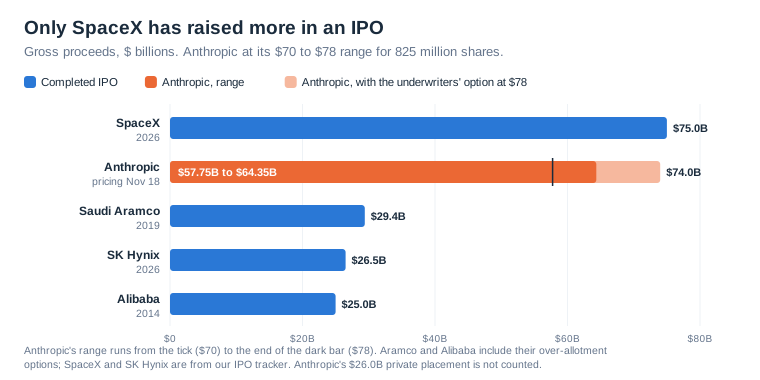
Before this year, the largest IPO on record was Saudi Aramco's $29.4 billion in 2019, and the largest in the US was Alibaba's $25.0 billion in 2014. At the bottom of its range, Anthropic's deal is about twice Aramco's.
Who Gets the Shares
Retail investors. The amendment says the company expects allocations to retail investors in the US and other countries to be up to 20 percent of the shares offered, depending on demand. At the midpoint that is up to 165 million shares, about $12.2 billion. Part of it goes through brokerages including Fidelity, Robinhood, SoFi, E*TRADE from Morgan Stanley and Trade-PMR. Outside the US, a public offer to individual investors in the UK opened on November 10, and Anthropic has filed prospectuses for offers in several European countries, Japan, Australia and Canada.
Directors. Board members and entities tied to them have indicated interest in buying up to $303 million of stock at the IPO price, $300 million of it through a donor-advised fund that director Reed Hastings set up and advises. These indications are not binding, and any shares bought are locked up.
The private placement. The seven partners buy non-voting Class N shares, 351.4 million in all at the midpoint, closing right after the IPO. The placement depends on the IPO and on approval by Anthropic's stockholders, which the company expects to get before closing; the IPO does not depend on the placement.
| Buyer | Shares at $74 | Amount |
|---|---|---|
| 135.1 million | $10.0 billion | |
| NVIDIA | 135.1 million | $10.0 billion |
| AMD | 33.8 million | $2.5 billion |
| Broadcom | 13.5 million | $1.0 billion |
| Micron | 13.5 million | $1.0 billion |
| Microsoft | 13.5 million | $1.0 billion |
| TSMC | 6.8 million | $0.5 billion |
Two of these settle questions from the earlier filings. Google is exercising in full its $10 billion option to buy alongside the IPO, our fourth number to watch, so the amount it can still provide under its 2026 note agreement falls to $10 billion from $20 billion. AMD's $2.5 billion counts toward its commitment to buy stock under its hardware supply agreement, which falls to $2.5 billion.
These shares are not locked up. They are unregistered, so they can only be resold under an exemption such as Rule 144 or once registered, and Anthropic does not have to publicly file a registration statement for Google's shares before the earlier of the second trading day after the first-quarter 2027 results or day 180.
Amazon. Its notes convert only up to its ownership cap, and the amendment says Amazon has chosen not to waive the cap for this offering. At the midpoint, about $579.3 million of the notes would convert at the IPO, into 276.8 million Class N shares; the final amount depends on the deal size. The rest stay outstanding and convert at the end of each quarter as far as Amazon's 12 percent cap allows, or are repaid in cash at maturity.
What It's Worth
The filing does not state a valuation, so the figure depends on the share count. Counting the 13.09 billion shares that will be outstanding after the IPO and the placement, the range values Anthropic at $916 billion to $1.02 trillion. That count leaves out 1.77 billion shares under options with an average exercise price of $2.91, 1.03 billion under unvested restricted stock units, the Amazon notes that stay outstanding and several share reserves.
The filing now adds them up itself. Its fully diluted table, which counts options by the treasury method, the restricted stock units, the Amazon notes that roll over, the donation matching shares and the Public Benefit Fund's 846.8 million shares, comes to 18.0 billion after the offering. That is $1.26 trillion to $1.41 trillion across the range, close to the 18.1 billion our first piece's method gives. At the midpoint the company is valued at about 12 times October run-rate revenue on shares outstanding and about 16.5 times on the fully diluted count.
Our last piece found that the filing's September 30 fair values implied about $70 a share. The bottom of the range lands there.
Run-Rate Revenue: About $81 Billion
The amendment fills in the figure the earlier filings left blank: run-rate revenue of about $81 billion on October 31, up $10 billion from September 30. The company calculates it as usage fees for the trailing 28 days ending on the date multiplied by 13, plus monthly subscription fees multiplied by 12. For comparison, third-quarter revenue of $17.0 billion is $67.8 billion a year.
The filing is careful about the measure. It is not a forecast, it annualizes a short window of mostly usage-based revenue, and it includes customers the company may later find are breaking its usage policy. The company still expects the growth rate of run-rate revenue to decline over time, possibly significantly.
Commitments: $900.9 Billion
The commitments total rose to $900.9 billion from $895.4 billion, with $451.6 billion expected before the end of 2030 and $70.7 billion due in the 12 months after September 30, up from $69.8 billion. An estimated $150 billion to $175 billion is still left out, for agreements that do not set a fixed dollar amount. Against the 12-month figure, the pro forma $212.7 billion of cash and short-term investments covers it three times over.
The Lock-Up, in Shares
The earlier filings gave the lock-up as percentages and dates. The amendment adds the shares:
- First trading day: up to 316 million shares, the 10 percent that non-founder directors, officers, employees and consultants can sell.
- Days 27, 48, 62 and 76 after the prospectus date: up to 299 million, 299 million, 349 million and 349 million. If the prospectus is dated November 18, day 27 is December 15 and day 76 is February 2.
- After the 2026 annual results: up to 1.7 billion, then 474 million at each of five steps over the following 69 days.
- At the earlier of the first-quarter 2027 results or day 180: up to 3.0 billion, then 449 million at each of four steps.
- After the second-quarter 2027 results: up to 562 million, then 505 million at each of five steps.
- At the earlier of the third-quarter 2027 results or day 365: up to 1.9 billion, the last step, which includes the rest of the co-founders' shares.
By our sum, that is 1.6 billion shares in the first 76 days, about twice the 825 million sold in the IPO, and about 5.7 billion before the step at the first-quarter results. Each amount is the most that can be sold, and Goldman Sachs and Morgan Stanley can release shares early.
The Seven Numbers, Answered
Our first piece listed seven numbers that would decide the deal. Six are now filled in.
| Number | After the second amendment |
|---|---|
| 1. The price range against $58.90 | $70 to $78, 19 to 32 percent above |
| 2. Third-quarter revenue and run-rate revenue | $17.0 billion; about $81 billion run-rate on October 31 |
| 3. The size of the deal and how much is insiders selling | 825 million shares, $57.75 billion to $64.35 billion; the co-founders sell 23.6 million |
| 4. Google's $10 billion option | Exercised in full, in a $26.0 billion placement with six other partners |
| 5. The commitment total and the next 12 months | $900.9 billion and $70.7 billion |
| 6. The lock-up share counts | 316 million on day one, 1.6 billion in 76 days, 15.5 billion in all |
| 7. Any capacity figure | Still none |
What Happens Next
The price is expected on November 18. It can land outside the range: deals that draw strong demand are often priced above it, sometimes after a new filing raises it, and weak demand can push it lower. Trading is expected to start on November 19. From then the IPO tracker shows the offer price, the first-day move and the return since. Up to 316 million locked-up shares can be sold from the first day of trading, and the next lock-up step comes 27 days after the prospectus date.
How we measured: figures are as filed in Anthropic's Form S-1/A of November 10, 2026 and the free writing prospectuses filed after it; 2026 interim amounts are unaudited. Deal sizes multiply 825 million shares, or 948.75 million with the underwriters' option, by the range. Values multiply 13,086,672,593 shares outstanding after the offering and the placement, which include the Public Benefit Fund's shares, by the range; the placement is a fixed $26.0 billion, so its share count, set here at the $74 midpoint, moves slightly with the price. The fully diluted values use the filing's table of 18,012,993,381 shares, also at the midpoint. Founder amounts are before the underwriting discount. Third-quarter revenue is annualized by multiplying by four. Lock-up totals add the amounts in the filing's release table. The size comparison takes Saudi Aramco and Alibaba with their over-allotment options and SpaceX and SK Hynix from our IPO tracker.
This piece is for informational purposes only and is not investment advice. Figures are as of November 12, 2026, and the terms can change before the shares are priced.
Comments (0)
No comments yet. Be the first.