Jensen Huang's 33 Years at Nvidia Ended in 14 Days
Written on Thursday, November 12, 2026. It covers news through about 4:30 p.m. ET Thursday and uses Thursday's closing prices, and the story is still moving. We will add a dated note when the numbers change.
Jensen Huang co-founded Nvidia in 1993 and ran it for 33 years. His tenure ended in 14 days. On October 29 the New York Times reported his close relationship with an executive at an Nvidia customer that U.S. officials were investigating. On November 11, at a board meeting that CNBC reported ran into the evening, the directors accepted his resignation as president, chief executive and director, and shortly before 9 a.m. ET on November 12 Nvidia announced it, "effective immediately." Chief financial officer Colette Kress is interim CEO and stays CFO. Harvey Jones, a director since 1993 and a former CEO of Synopsys, becomes the company's first board chair. The board will look at internal and external candidates for the permanent job. The 8-K gives no reason and no separation terms. NBC News reported that a company spokesperson said Huang will not work with Nvidia in any capacity going forward (NBC News).
What makes the sequence worth studying is what the board tolerated and what it did not. It stood behind Huang through reporting that tied him to a woman U.S. intelligence officials reportedly believe works for China's Ministry of State Security. It reversed within about a day of a second Times report, published after the close on November 11, that he had a relationship with a vice president who reported to him. Nvidia has not said which report decided it. The timing, and the way other boards have handled relationships with subordinates, make the link hard to miss.
The stock tells the same story from a different angle. Through November 6 Nvidia fell less than the rest of the chip sector, because most of that slide was a sector selloff. From Monday, November 9, after Huang admitted to staff that he had been unfaithful to his wife, it fell while the sector rose. We go through the timeline, what the stock, the options market, the leveraged ETFs and the prediction markets did, what Wall Street changed, the board and its lawsuits, Washington, who runs Nvidia now, and what past CEO exits say about the months ahead.
The Short Version
- The board backed Huang on November 8, and a spokesman said on November 10 that he would stay during the review. The board then accepted his resignation on November 11, hours after the Times reported a relationship with a direct report and the Wall Street Journal reported that the board was preparing to force him out.
- After the resignation, Reuters reported another relationship. On Thursday afternoon it said, citing two people familiar with the matter, that Huang had an intimate relationship with a second Nvidia employee, separate from Powell. It did not name her. Nvidia declined to comment, and the report has not been confirmed.
- The espionage claim is unproven in public. It rests on an intelligence memo described to reporters by unnamed officials. No agency has confirmed it, China denies it, the board said it had no reason to believe national security or Nvidia's secrets were compromised, and no charges have been reported. On Thursday afternoon Attorney General Todd Blanche said the Justice Department had not reached a conclusion on whether Alice Huang is a spy, and that the FBI was investigating the reports.
- Nvidia fell 6.9% from the November 6 close to the November 11 close while the semiconductor ETF SMH rose 9.3% and AMD rose 23.1%. Before that, Nvidia had held up better than the sector.
- On Thursday the stock opened at $151.01 and touched $148.80, 14.4% below Wednesday's close. At the low, the one-day loss in market value was about $600 billion, briefly more than the record of about $593 billion that Nvidia closed with on DeepSeek day in January 2025. It closed at $166.19, down 4.3% on the day and 11.7% above the low, so the record stands.
- Super Micro fell 11.3%, most of it before Bloomberg reported a federal inquiry in Manhattan into whether entities linked to Alice Huang smuggled its products into China. Super Micro says Megaspeed has never been its customer, and reporting names a different supplier for Megaspeed's servers.
- Options got expensive before Huang's admission. Our 30-day at-the-money implied volatility went from 28.6% on October 6 to 40.8% on October 28, before the first report, and to 62.4% on November 5, the day of a post-midterm chip selloff. The November 18 expiry, the first after the November 17 earnings report, priced a move of about 9.5% either way at Thursday's close, well above the 5.9% options priced before each of the last two reports.
- Prediction markets followed the news. Polymarket's year-end contract sat near 16% from November 9 to Wednesday morning, then jumped to about 75% that evening after the second report.
- At least nine brokers downgraded the stock in about a day, with most new targets between $174 and $250. Most framed the cuts as a lower multiple, not lower earnings.
- Huang owned about 870.6 million shares (3.58%) as of March, worth about $188 billion at the October 28 close and about $145 billion at Thursday's close.
- The liabilities stay with the company, and they run for years: a securities class action filed November 9, likely Delaware oversight claims, a federal investigation of the customer at the center of the story, Justice Department inquiries that Semafor reported on Thursday, testimony Huang has agreed to give Congress before Thanksgiving according to the House Foreign Affairs chairman, and a Democratic Congress from January. If the class action survives a motion to dismiss, depositions would most likely come in 2028 or later.
- History says the successor matters more than the scandal. CEO exits over personal conduct usually cost 0% to 3% on day one. HP in 2010 is the exception, and it looks most like Nvidia: a CEO credited with the business, the CFO as interim, no successor named. A year later, four of the seven stocks we checked trailed the S&P 500, by a median of about 16 points, and the legal fallout ran for years: McDonald's sued its former CEO nine months after his exit, after finding more relationships, and recovered more than $105 million.
How It Unfolded
The background starts a year earlier. In October 2025, U.S. and Singaporean authorities were investigating Megaspeed, an Nvidia customer suspected of helping Chinese companies get around export controls, and Nvidia said it had no reason to believe its products had been diverted (CNBC). Later Times reporting, relayed by other outlets, says that by spring 2026 officials had circulated a memo warning that a Megaspeed executive, Alice Huang (no relation to Jensen Huang), was working for China's Ministry of State Security, and that officials believed the relationship had made it harder to rein in Nvidia's chip sales (The New York Times, via The Nightly). Nvidia closed at its record, $239.24, on October 6.
| Date (2026) | What happened | Source |
|---|---|---|
| Oct 2025 | Megaspeed is reported to be under investigation for helping Chinese companies evade export controls. Nvidia's spokesman says staff "found no evidence of diversion" and that Huang's visits to customers are routine. | CNBC; Decrypt |
| Thu, Oct 29 | The Times reports Huang's close relationship with a Megaspeed executive under investigation by U.S. officials. Nvidia's spokesman calls his interactions with her "not unusual or unexpected" and says that if the U.S. government believed anyone was a threat to American industry, "it would let us know." | TechCrunch timeline |
| About Oct 30 | Huang tells Bloomberg his dealings with her, which he ties to Megaspeed's business, were "normal and not unusual." | Bloomberg, via Yahoo Finance; Al Jazeera |
| Wed, Nov 4 to Thu, Nov 5 | Three House committee chairs (Moolenaar, Mast and Crawford) ask Huang for a closed-door briefing on November 18, with a reply due November 11. The letter is dated November 4 and released November 5. | House China Select Committee |
| Thu, Nov 5 | Nvidia falls 9.3% in a broad chip selloff after the midterm elections, before any admission. | 24/7 Wall St |
| Fri, Nov 6 (evening) | The Times reports an intelligence memo saying the Ministry of State Security recruited her "to collect information on him." It says it is not clear when or how they met. Nvidia responds that it "neither has nor shares classified information with customers." | Bloomberg, via Yahoo Finance |
| Sun, Nov 8 | Huang emails staff: "I was unfaithful to my wife," his first admission. The board opens an investigation by a committee of independent directors with outside counsel and says it has confidence in him. | Nvidia; Nvidia board |
| Mon, Nov 9 | Nvidia falls 4.3% while the S&P 500 rises. A shareholder class action is filed. President Trump says the FBI is looking into it "in terms of something else" and that Huang told him he had "absolutely no idea" she was a spy. China's foreign ministry calls the claims smears. | ABC News; Decrypt; TechCrunch timeline; Al Jazeera |
| Tue, Nov 10 | The independent directors hire Joon H. Kim, a former acting U.S. Attorney for the Southern District of New York, and Wachtell, Lipton, Rosen & Katz. A spokesman says Huang stays on during the review. | Nvidia independent directors; The Next Web |
| Wed, Nov 11 (after the close) | The Times reports a relationship with Kimberly Powell, Nvidia's vice president of health care. Minutes later the Journal reports the board is preparing to force Huang out. The board meets into the evening. | TechCrunch timeline; CNBC |
| Thu, Nov 12 | Nvidia announces the resignation before the open. The SEC accepts the 8-K at 8:52 a.m. ET; it dates the event November 11. | Nvidia; EDGAR |
| Thu, Nov 12 (about 8 a.m.) | Singapore's Ministry of Home Affairs says it found insufficient evidence in February that Alice Huang committed offenses in its Megaspeed case, but warned her for giving police inaccurate information and barred her from reentering Singapore. It says it was not investigating espionage. | Mothership |
| Thu, Nov 12 (late morning) | House Foreign Affairs chairman Brian Mast says Huang, threatened with a subpoena, has agreed to testify before Thanksgiving. Bloomberg reports a Manhattan federal inquiry into whether entities linked to Alice Huang smuggled Super Micro products into China. | Yahoo Finance live; Bloomberg, via Investing.com |
| Thu, Nov 12 (about 2 p.m.) | Semafor, citing two administration officials, reports a Justice Department antitrust probe focused on Nvidia and two inquiries into Megaspeed and Super Micro concerning Alice Huang. | Semafor |
| Thu, Nov 12 (about 2:25 p.m.) | Reuters, citing two people familiar with the matter, reports that Huang had an intimate relationship with a second Nvidia employee. It lists Alice Huang and Powell as the two relationships already reported and does not name her. Nvidia declines to comment; Huang, Powell and a board representative do not reply. | Reuters, via Devdiscourse |
| Thu, Nov 12 (about 4 p.m.) | Attorney General Todd Blanche says the Justice Department has not reached a conclusion on whether Alice Huang is a Chinese spy, and that the FBI is investigating the reports. | Reuters, via Yahoo |
Until November 8, Nvidia's public answers treated the contact as ordinary business. Its spokesman called Huang's interactions with her "not unusual or unexpected"; Huang told Bloomberg his dealings were "normal and not unusual"; and after the memo report the company said it "neither has nor shares classified information with customers." None of them addressed a romantic relationship. On November 8 Huang admitted the infidelity himself, and his email mentioned the espionage reporting only as "the national security concerns raised in news reports." The class action filed the next day is built on four of the earlier statements: the two from October 2025, the spokesman's October 29 comment and Huang's remark to Bloomberg (Decrypt).
Huang's November 8 email named no one and referred only to "the national security concerns raised in news reports" (Nvidia). The board's statement the same day said it had "no reason to believe that either national security or NVIDIA secrets were compromised" (Nvidia), and a company spokesperson said Huang would keep leading Nvidia "without interruption" (CNBC). On November 10 the independent directors hired the outside lawyers, and a spokesman again said Huang would remain CEO during the review.
Wednesday changed that. Representative John Moolenaar said subpoenas were likely if Huang declined the briefing (TechCrunch). Shortly after the market closed, the Times reported the relationship with Powell, citing five people who had worked at Nvidia; according to the Times she reported directly to Huang (TechCrunch timeline). Nvidia and Powell did not respond to CNBC's requests for comment. Within minutes the Journal reported the board was preparing to remove him, possibly as soon as that night (SF Standard), and CNBC reported that the board meeting stretched into the evening (CNBC). Nvidia's release calls it a resignation; Bloomberg reported that the board removed him.
What Ended It
The board's stated confidence survived the espionage reporting, the House letter and Huang's own admission. It lasted about a day after a report about a direct report. Other boards have a long record of acting quickly on that kind of report. Intel's Brian Krzanich resigned in 2018 over a past relationship with an employee that broke company policy (SiliconANGLE). McDonald's fired Steve Easterbrook in 2019 over a relationship with an employee (CNBC). Nestlé dismissed Laurent Freixe in 2025 over an undisclosed relationship with a direct subordinate (Al Jazeera). In 2005 Boeing's chairman said Harry Stonecipher's affair with an executive did not break the code of conduct but impaired his ability to lead (Seattle Times).
According to the Times, Nvidia's code of conduct lists personal relationships as a possible conflict of interest and tells employees with a conflict to step back from related decisions and seek legal advice (via The Nightly). Even before the second report, University of Chicago law professor Todd Henderson said that not telling the board about the Alice Huang relationship would itself be a fireable offense (TechCrunch). A relationship with a subordinate is something a board can verify and judge against its own policy in an evening. An intelligence assessment it cannot see is not.
The espionage case, meanwhile, remains where it was on November 6. It rests on anonymous officials and a memo the public has not seen; NBC's confirmation came from a single person familiar with the matter (NBC News). The Times reports no public evidence that Huang passed on sensitive information, knew of her alleged role, or broke export rules. China's foreign ministry said on Thursday that Washington was inventing spy stories to justify a technology blockade (Al Jazeera). Still unknown: who sits on the investigating committee, whether its review continues now that Huang is gone, whether the board knew about the relationship with Powell, or the one Reuters reported on Thursday, before November 11, and whether Huang answered the House by its deadline.
Singapore added to the record on Thursday. Its Ministry of Home Affairs said police and customs have investigated Megaspeed since February 2025 over possible false declarations in server purchases; the servers were exported through Singapore to Malaysia without entering the Singapore market. It said Alice Huang was investigated as Megaspeed's then chief executive and a controller, not for espionage. In February 2026 police found insufficient evidence that she had committed those offenses, but concluded she had given them information she knew to be inaccurate to play down her role, issued a stern warning and barred her from reentering Singapore. The ministry said a U.S. Commerce Department check at Megaspeed on June 24, 2025, with her present, was the first Singapore knew of U.S. interest, and that its investigation of Megaspeed and six other people continues (Mothership).
Thursday afternoon brought a report of a third relationship. At about 2:25 p.m. ET Reuters said, citing two people familiar with the matter, that Huang had an intimate relationship with a second Nvidia employee, after the relationships with Alice Huang and Powell (Reuters, via Devdiscourse). Reuters did not name her, and its report, which we read in syndicated copies (Reuters, via HuffPost), does not give her job, say whether she reported to Huang or say when the relationship took place. Nvidia declined to comment; Huang, Powell and a representative for the board did not reply, and Reuters could not reach the woman. It changes nothing about who runs Nvidia, but it adds to what the independent directors' investigation, if it continues, and the lawsuits below may look at. Nvidia's stock slipped about half a percent within three minutes of the report, on two to three times the trading volume of the minutes before. By 4:30 p.m. we found no other outlet reporting it independently; CNBC, Yahoo Finance and others carried it credited to Reuters. Nvidia had issued no further statement and filed nothing new with the SEC.
The Stock
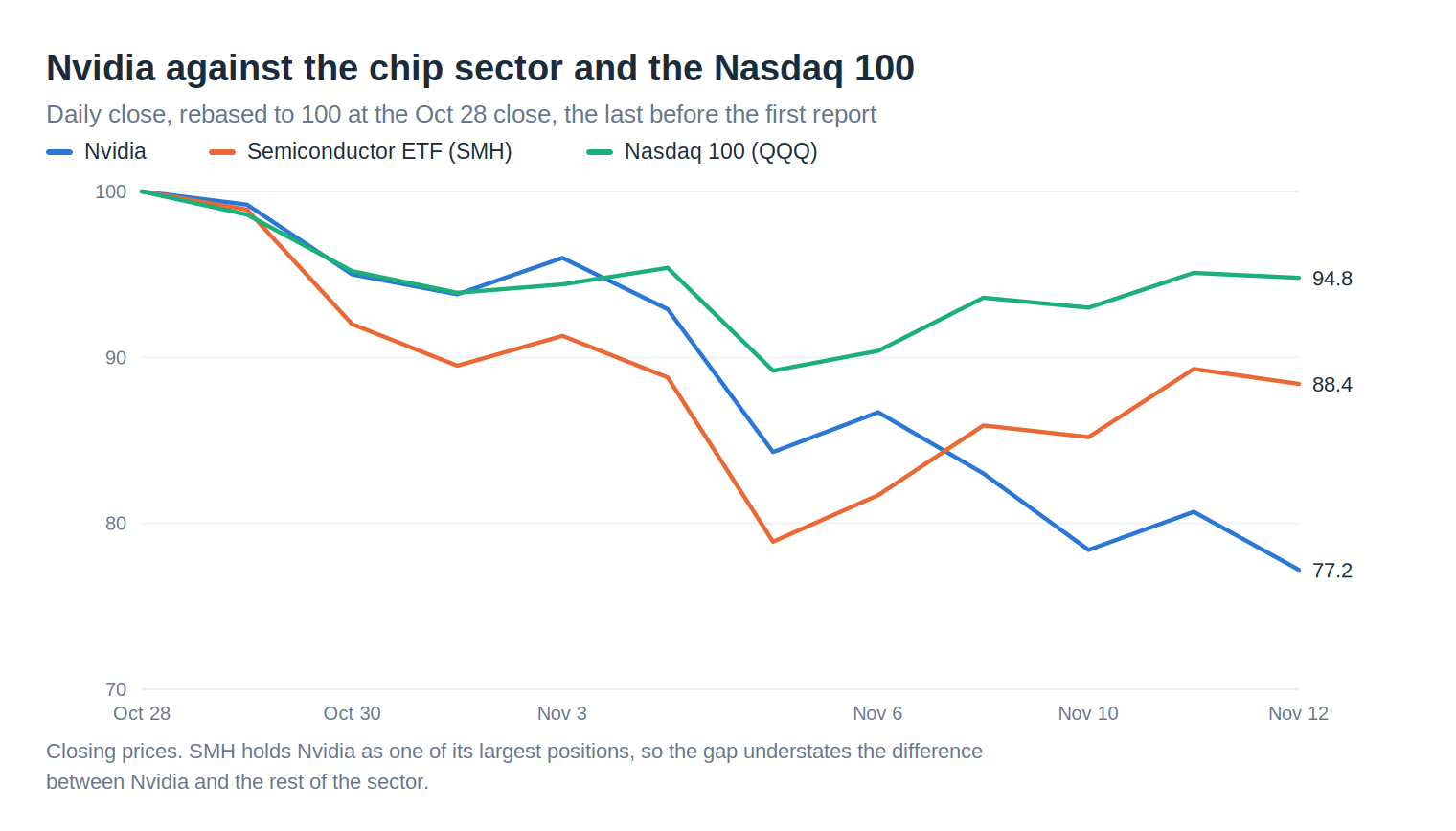
Measured from the last close before the first report, October 28, Nvidia was down 19.3% by Wednesday's close, against 10.7% for SMH and 4.9% for the Nasdaq 100 ETF; by Thursday's close the figures were 22.8%, 11.6% and 5.2%. But almost none of that gap opened before Huang's admission. Through November 6 Nvidia was down 13.3%, less than SMH's 18.3%. The two big down days in that stretch, October 30 and November 5, were sector days. November 5 followed midterm results that investors read as bad for data center spending (24/7 Wall St); by our figures SMH fell 11.2% that day, AMD 17.3% and Micron 17.5%, all more than Nvidia's 9.3%.
| Date | Event | NVDA close | NVDA | SMH | QQQ | S&P 500 (SPY) |
|---|---|---|---|---|---|---|
| Oct 28 | Last close before the first report | $215.38 | -1.2% | +1.7% | +0.6% | +0.3% |
| Oct 29 | First Times report | $213.66 | -0.8% | -1.1% | -1.4% | -0.4% |
| Oct 30 | Chip selloff; Huang calls his dealings normal | $204.64 | -4.2% | -7.0% | -3.5% | -1.8% |
| Nov 4 | House letter dated | $200.13 | -3.2% | -2.7% | +1.0% | +1.7% |
| Nov 5 | Post-midterm chip selloff | $181.60 | -9.3% | -11.2% | -6.5% | -4.4% |
| Nov 6 | Memo report after the close | $186.64 | +2.8% | +3.6% | +1.4% | +0.3% |
| Nov 9 | First session after the admission | $178.67 | -4.3% | +5.1% | +3.5% | +2.4% |
| Nov 10 | Outside counsel hired | $168.89 | -5.5% | -0.8% | -0.7% | -0.4% |
| Nov 11 | Second report after the close | $173.73 | +2.9% | +4.8% | +2.3% | +1.3% |
| Nov 12 | Resignation | $166.19 | -4.3% | -1.0% | -0.3% | -0.4% |
Closing prices from our daily data. The table skips November 2 and 3.
November 9 is the cleanest read of the scandal on its own: Nvidia fell 4.3% on a day SMH rose 5.1% and AMD 13.3%. Over the three sessions from November 9 to 11, the gap between Nvidia and SMH was about 16 percentage points.
Then came the night of November 11. Our five-minute data shows the stock at $173.73 at the 4 p.m. close, $156.20 at the after-hours low and $158.78 at 8 p.m., down 8.6%, on 77 million shares traded after hours, about eight times the previous evening. Thursday's pre-market trading fell further once the announcement came out. The regular session opened at $151.01, hit $148.80, then recovered to close at $166.19, down 4.3%, on 735 million shares. That is about five times the 30-day average and the heaviest trading of the year in our data.
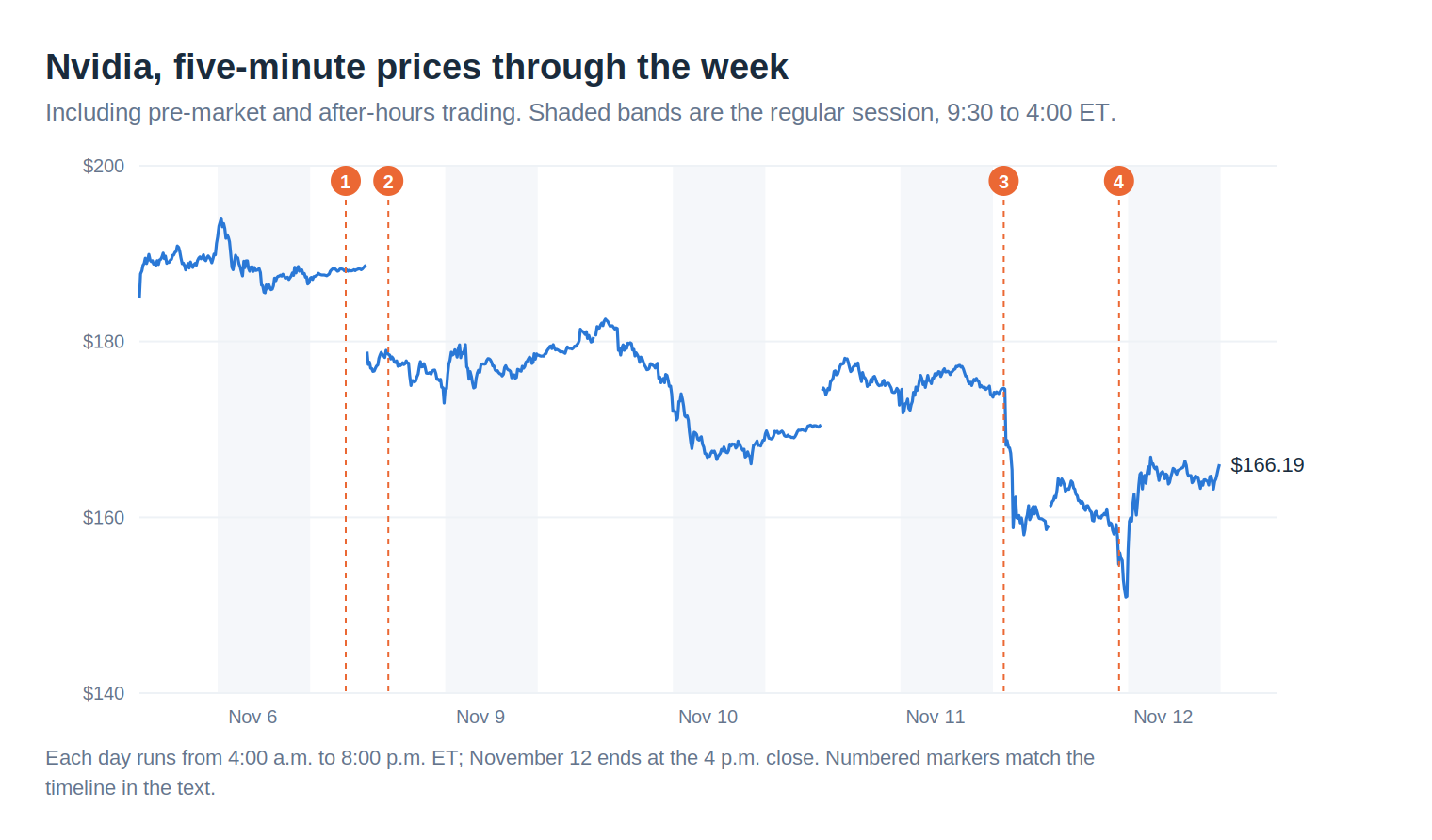
Markers: 1, the memo report on the evening of November 6, after trading ended. 2, Huang's email and the board's statement on Sunday, November 8 (shown at Monday's pre-market open). 3, the Times and Journal reports shortly after 4:40 p.m. ET on November 11. 4, the 8-K, accepted by the SEC at 8:52 a.m. ET on November 12.
Market Value
With 24.1 billion shares outstanding, Nvidia was worth about $5.77 trillion at its October 6 record, $5.19 trillion on October 28, $4.50 trillion on November 6 and $4.19 trillion at Wednesday's close. At Thursday's low it was worth about $3.59 trillion, and at Thursday's close about $4.01 trillion. Reported losses ran from $440 billion to about $2 trillion because outlets measured from different starting points (Yahoo Finance live). Here is the arithmetic on one basis:
| Measured from | Close | To Thursday's low ($148.80) | To Thursday's close ($166.19) |
|---|---|---|---|
| Record, Oct 6 | $239.24 | -$2.18 trillion | -$1.76 trillion |
| Before the first report, Oct 28 | $215.38 | -$1.60 trillion | -$1.19 trillion |
| Before the admission, Nov 6 | $186.64 | -$912 billion | -$493 billion |
| Wednesday, Nov 11 | $173.73 | -$601 billion | -$182 billion |
The record one-day loss for any company is still Nvidia's own on January 27, 2025, when DeepSeek's cheap model raised questions about AI spending and the stock fell nearly 17%, erasing about $593 billion (Reuters, via Yahoo Finance). Thursday's low briefly passed it on an intraday basis. It did not set a closing record: on our share count that needed a close below about $149.12, and the stock closed at $166.19, a one-day loss of about $182 billion.
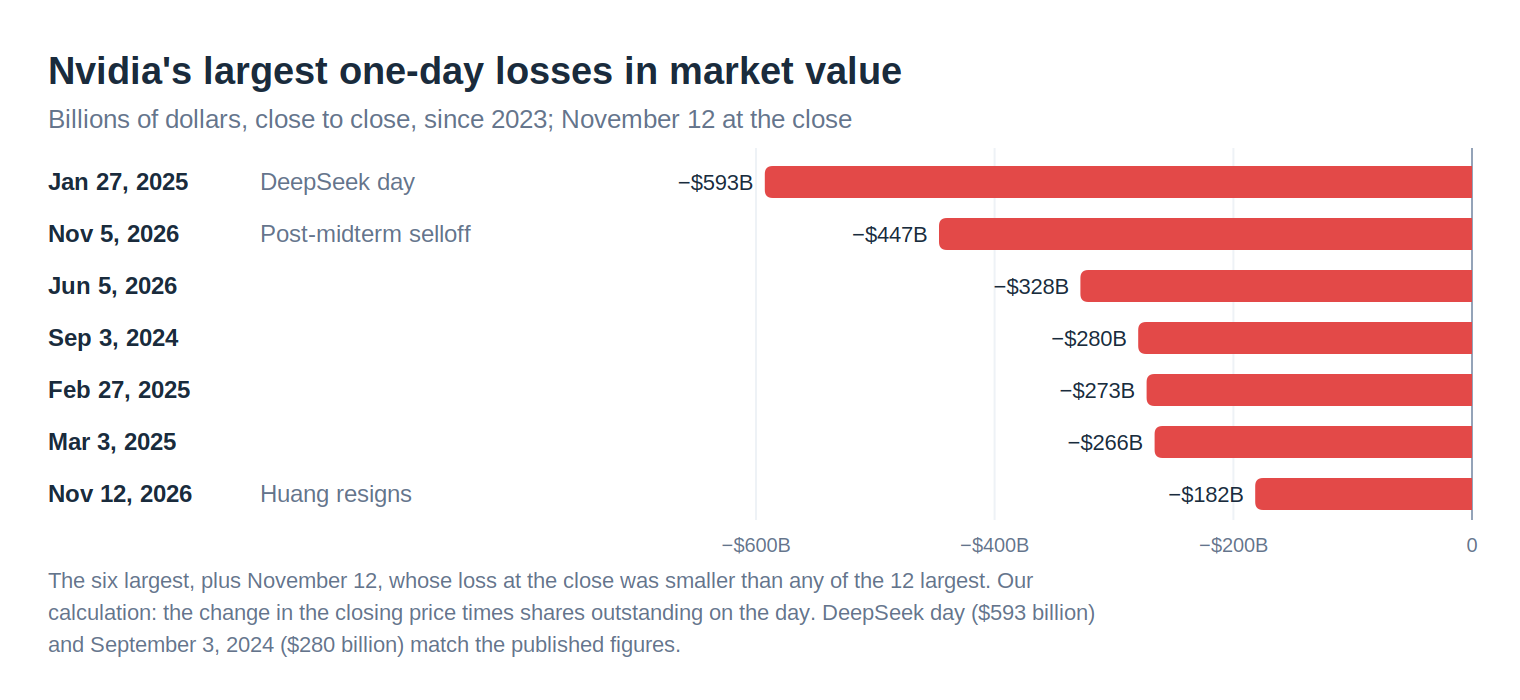
On our numbers, all of Nvidia's largest one-day losses came in the past two years. The second largest, November 5, came one week before the resignation and had nothing to do with it.
The stock had other problems. It was on course for a sixth straight weekly decline, its longest losing streak since 2012, and was down about 7% for the year at Wednesday's close (CNBC live). Middle East tension weighed on stocks at the open (TipRanks), and the market ended slightly lower, with the S&P 500 ETF down 0.4% and the Nasdaq 100 ETF down 0.3%.
Huang's Own Stake
Huang owned 870,604,104 Nvidia shares, 3.58% of the company, as of March 23, mostly through family trusts, LLCs and a foundation (2026 proxy). At that count the stake was worth about $188 billion at the October 28 close and about $145 billion at Thursday's close, a paper loss of roughly $43 billion. Nvidia has one class of stock, so he holds no extra votes to contest the board, and he is now off it. His latest Form 4, filed September 18, shows only shares withheld for taxes and a charitable gift, with the 10b5-1 plan box unchecked (Form 4); we found no confirmed 2026 sales plan. His filings are on our insider page for Jensen Huang. No outlet has reported any plan to sell. Once he is neither an officer nor a director, his Form 4 duties will eventually lapse, which would make any future sales harder to track, though Form 144 notices would still show sales while he counts as an affiliate.
Rivals Rose, Customers Fell
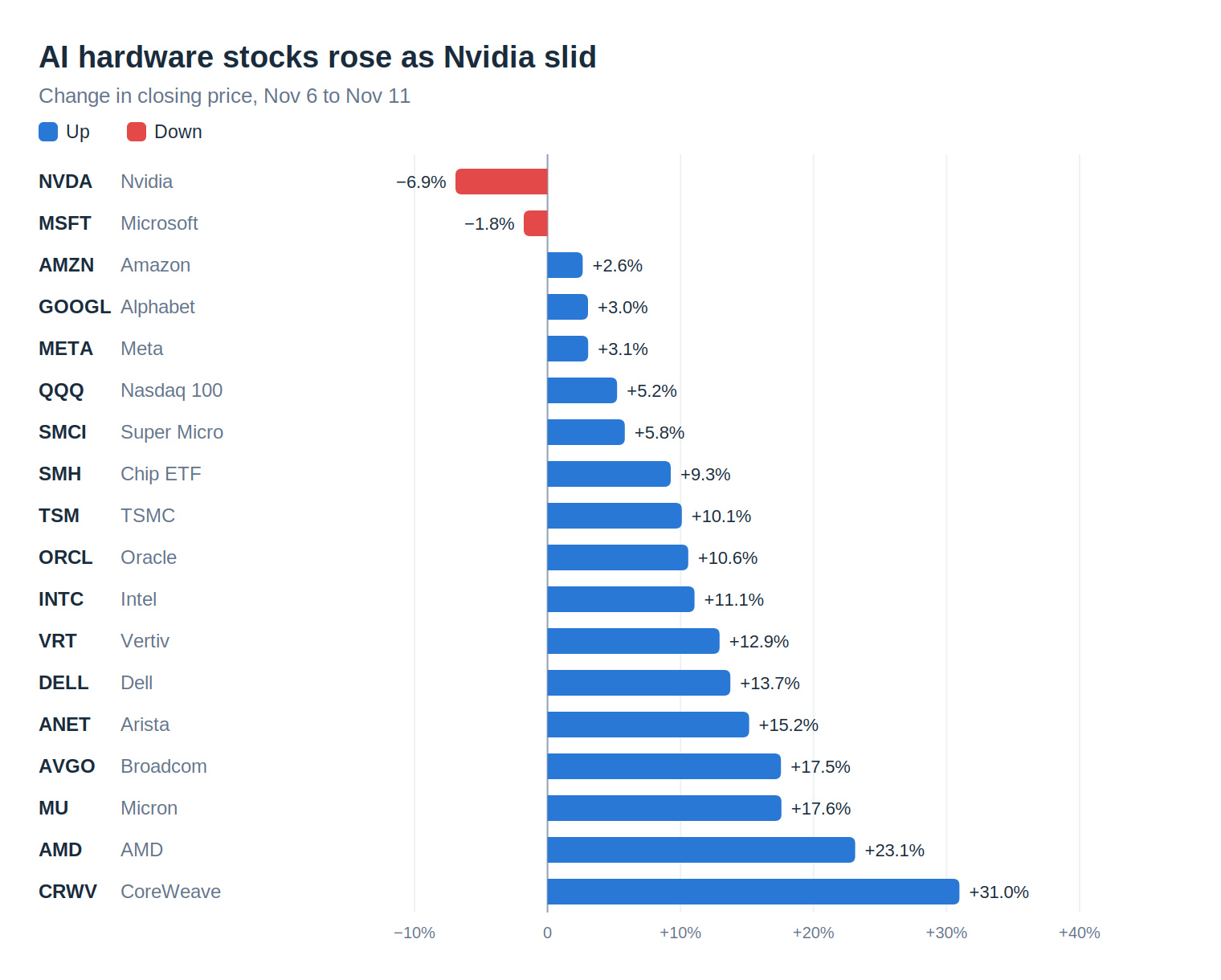
From the November 6 close to the November 11 close, the market treated Huang as a risk specific to Nvidia, not a shock to AI demand. AMD gained 23.1%, Broadcom 17.5%, Micron 17.6%, Arista 15.2% and TSMC 10.1%. CoreWeave gained 31.0%, most of it on Wednesday after its own quarterly results (Yahoo Finance). Only Nvidia and Microsoft fell.
Thursday split along a different line. AMD closed up 5.9% and Broadcom 5.5%. The companies that rent out Nvidia's chips or depend on its orders closed down: Nebius 16.8% (it also reported results), Super Micro 11.3%, CoreWeave 6.9%, Intel 2.1%, TSMC 1.9%, Micron 1.6% and Dell 0.7%. Alibaba fell 7.1%; Investing.com tied its Hong Kong drop to closer U.S. scrutiny of chip exports and noted that Alibaba rented Nvidia chips through Megaspeed (Investing.com). Seoul Economic Daily reported that Bernstein's Stacy Rasgon said China would be the biggest beneficiary if Huang left (Seoul Economic Daily).
One reading of that split: investors see Nvidia's balance sheet and Huang's deal making as part of what holds the GPU-financed build-out together, while demand for computing itself looks intact. CNBC put Nvidia's obligations to other companies at about $400 billion (CNBC live). That reading is ours, and two earnings reports muddy Thursday's signal.
Ordinary savers are exposed too. Nvidia is roughly 6% to 8% of the S&P 500, depending on the count, and about 10% of the Nasdaq 100 (Fortune; The Daily Upside, via Yahoo Finance). Leonard Gilroy of the Reason Foundation told Fortune that a typical 401(k) holds 3% to 5% in Nvidia.
Super Micro and Megaspeed
Super Micro, the server maker that builds systems around Nvidia's chips, fell 11.3% on Thursday on 114 million shares, more than twice its volume on any of the four days before. Most of the drop came before any news about Super Micro itself: it fell with Nvidia after hours on Wednesday and opened down 10.4%. It had recovered to about $28.84 by 11:15 a.m. when Bloomberg, citing one person familiar with the matter, reported that the U.S. attorney's office in Manhattan is investigating whether entities linked to Alice Huang were involved in smuggling Super Micro products into China. It was unclear whether that work is connected to existing smuggling cases, and Super Micro is not a defendant (Bloomberg, via Investing.com). In our five-minute data the stock reached its low of $25.70 at 11:55 a.m. That afternoon Semafor, citing two administration officials, reported that two Justice Department inquiries, into Megaspeed and Super Micro, have focused on Alice Huang's involvement, alongside a separate antitrust probe focused on Nvidia (Semafor).
Is Super Micro tied to Megaspeed? Not directly, on what has been documented. A Super Micro spokesperson told Semafor that "Megaspeed is not, and has never been, a Supermicro customer," and that the company has cooperated with U.S. and Taiwanese officials and engaged with all of Singapore's requests. The New York Times traced the Nvidia chips that Megaspeed's affiliate bought, through Malaysian import records, to Aivres, the California subsidiary of Inspur, a Chinese company the U.S. has sanctioned (Mothership). Fortune found no evidence so far that the Super Micro and Megaspeed cases are directly connected, though a short seller has alleged links (Fortune).
Singapore's account is less comfortable for Super Micro. Its Ministry of Home Affairs said police investigating Megaspeed sought information about Super Micro, which "provided limited cooperation," and that repeated requests to the Justice Department and the FBI for help since September 2025 brought limited assistance (Mothership). Super Micro also has a case of its own. In March, prosecutors in Manhattan charged its co-founder Wally Liaw and two others with conspiring to divert servers with Nvidia chips to China through a Southeast Asian buyer; the company was not charged, Liaw has pleaded not guilty and has left, and Super Micro says it is cooperating (Justice Department; Bloomberg, via Investing.com). Its latest annual report discloses a grand jury subpoena and inquiries from the Commerce Department's export enforcement office, says it has not been told it is a target, and warns that the department could seek to suspend or deny its export privileges (Super Micro 10-K). In what we found, no lawmaker has called for a new investigation of Super Micro over Megaspeed, and none of the smuggling allegations against Megaspeed or Super Micro has been proven.
The Options Market
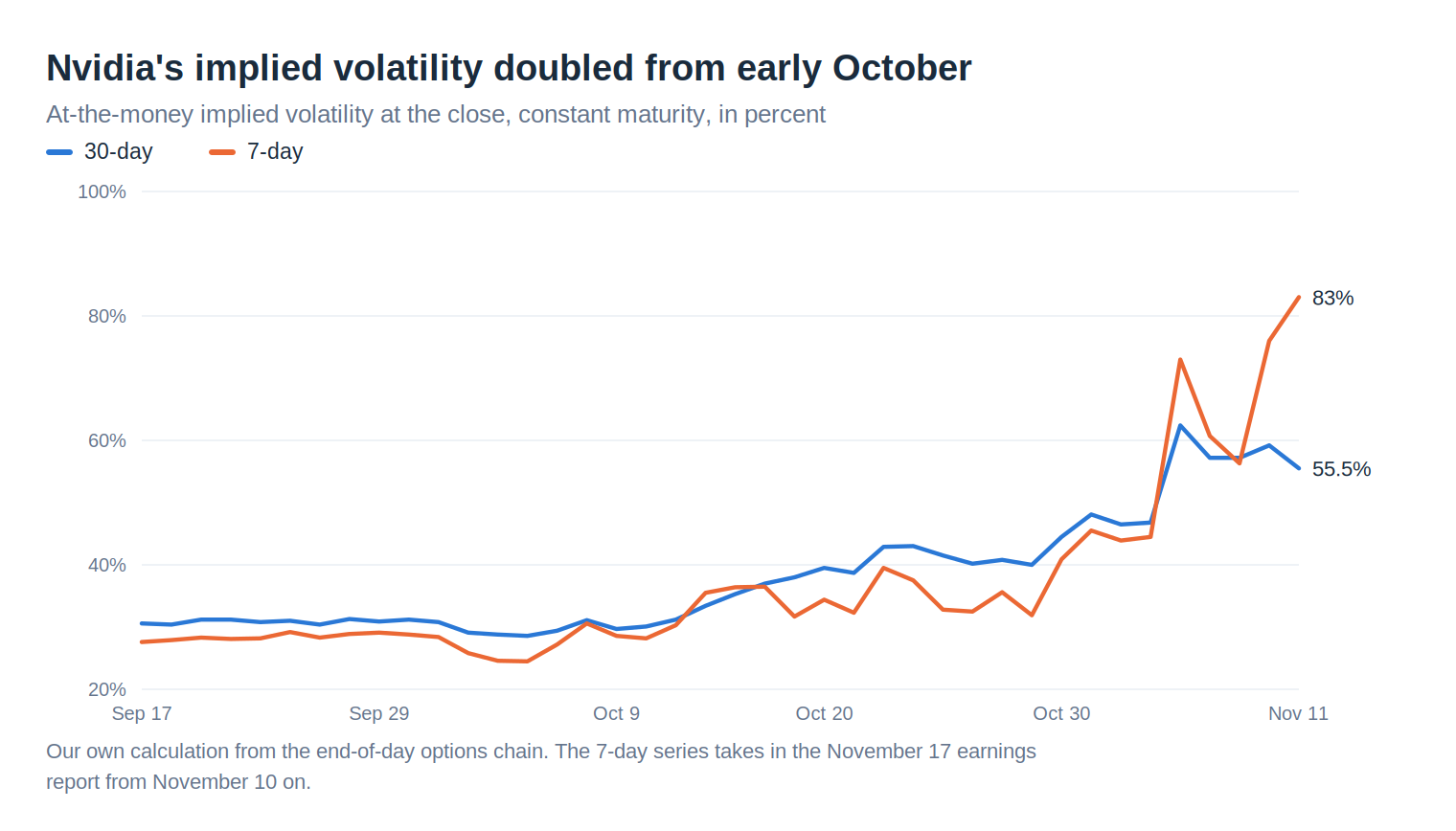
Implied volatility is the options market's estimate of how much a stock will move. Our 30-day at-the-money measure for Nvidia was 28.6% on October 6, rose through October as the stock slid, and hit 62.4% on November 5, the post-midterm selloff, before Huang's admission. It was 40.8% on October 28, the last close before the first report, and 55.5% at Wednesday's close. The 7-day measure, which has taken in the November 17 earnings report since about November 10, was 83.0%. Options traders were paying up for Nvidia before Huang's admission turned the story into a question about whether he would keep his job.
The cleanest number is the expected move into earnings. At Thursday's close, with the stock at $166.19, the at-the-money straddle for the November 18 expiry, the first after the report, cost about $15.80, which implies a move of about 9.5% either way by that Wednesday. It was priced four sessions early, so it also covers ordinary movement before the report. Measured the same way at the close before each report, options implied 5.9% before both May's and August's reports. Over the past 12 reports Nvidia moved an average of 5.6% in the session after, against an average implied move of 7.7%, and it moved more than implied only 3 times, most recently in August, by 8.7% (our Nvidia earnings history). The report on November 17 and the monthly options expiration on November 20 fall in the same week, and Huang's testimony, which Mast says will come before Thanksgiving, may too. Kress's first call as interim CEO comes with the report.
Traders were buying protection and buying the dip at the same time. In our end-of-day options data, Nvidia's put volume was 3.2 million contracts on November 10, the fifth-highest of any day since January 2025, and 4.2 million on Thursday, second only to DeepSeek day (4.35 million on January 27, 2025). Calls kept pace. The put-to-call volume ratio ran between 0.59 and 0.83 from November 9 to 12, mostly above its median of 0.61 since 2025 but below 1, a level it has passed on only three trading days in that time. Thursday's 9.2 million contracts in all were also second only to DeepSeek day. Nvidia's quote page shows each day's call and put volume across all expiries and the ratio (our Nvidia options activity). You can follow Nvidia's options flow on our options volume page.
The Leveraged ETFs
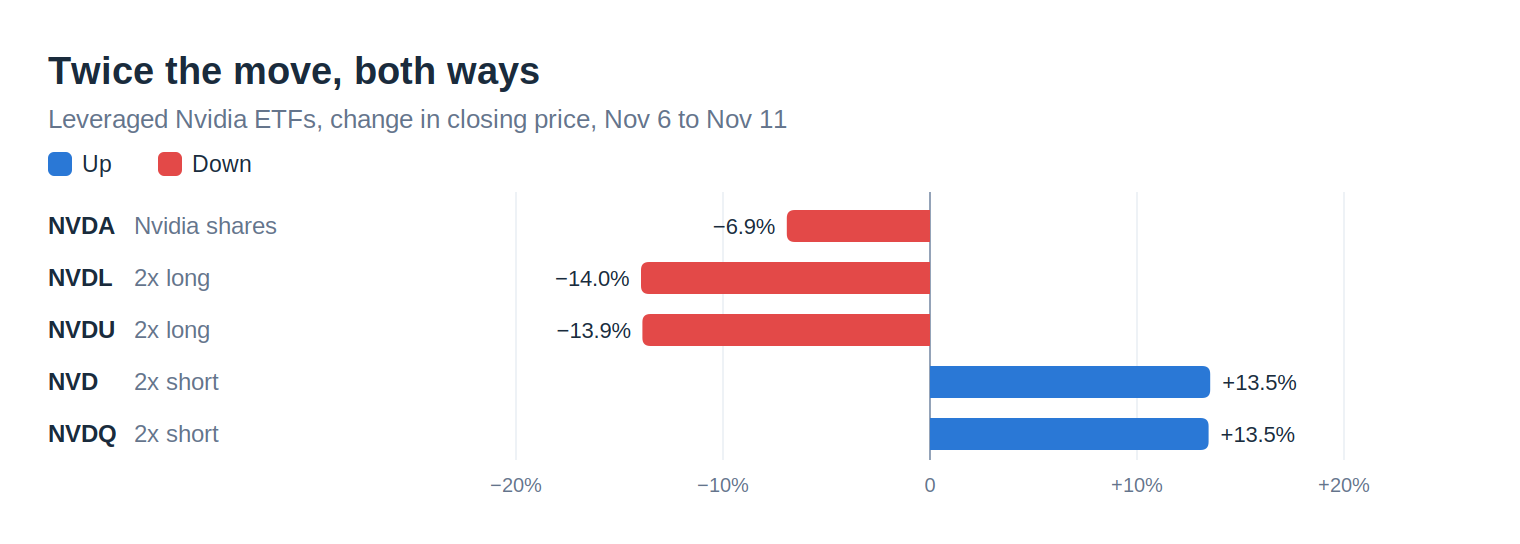
The single-stock leveraged funds did what they are built to do, which is double each day's move. From the November 6 close to the November 11 close, Nvidia fell 6.9%, while the 2x long funds NVDL and NVDU fell about 14%, a bit more than double because daily resetting compounds the losses in a choppy week. The 2x short funds NVD and NVDQ both rose about 13.5%. On Thursday NVDL opened down about 26% and closed down 9.0%.
Investors kept buying the long side. By our daily data, NVDL traded about $1.28 billion on November 10, 3.8 times its average over the previous 30 sessions, and $2.27 billion on Thursday on 131 million shares, 5.7 times (our NVDL page). Tidal Financial's Steve Foy said leveraged funds tend to see dip buying "in a really big way" (The Daily Upside, via Yahoo Finance). Our leveraged ETF page tracks how far each fund drifts from twice its stock over longer periods.
The Prediction Markets
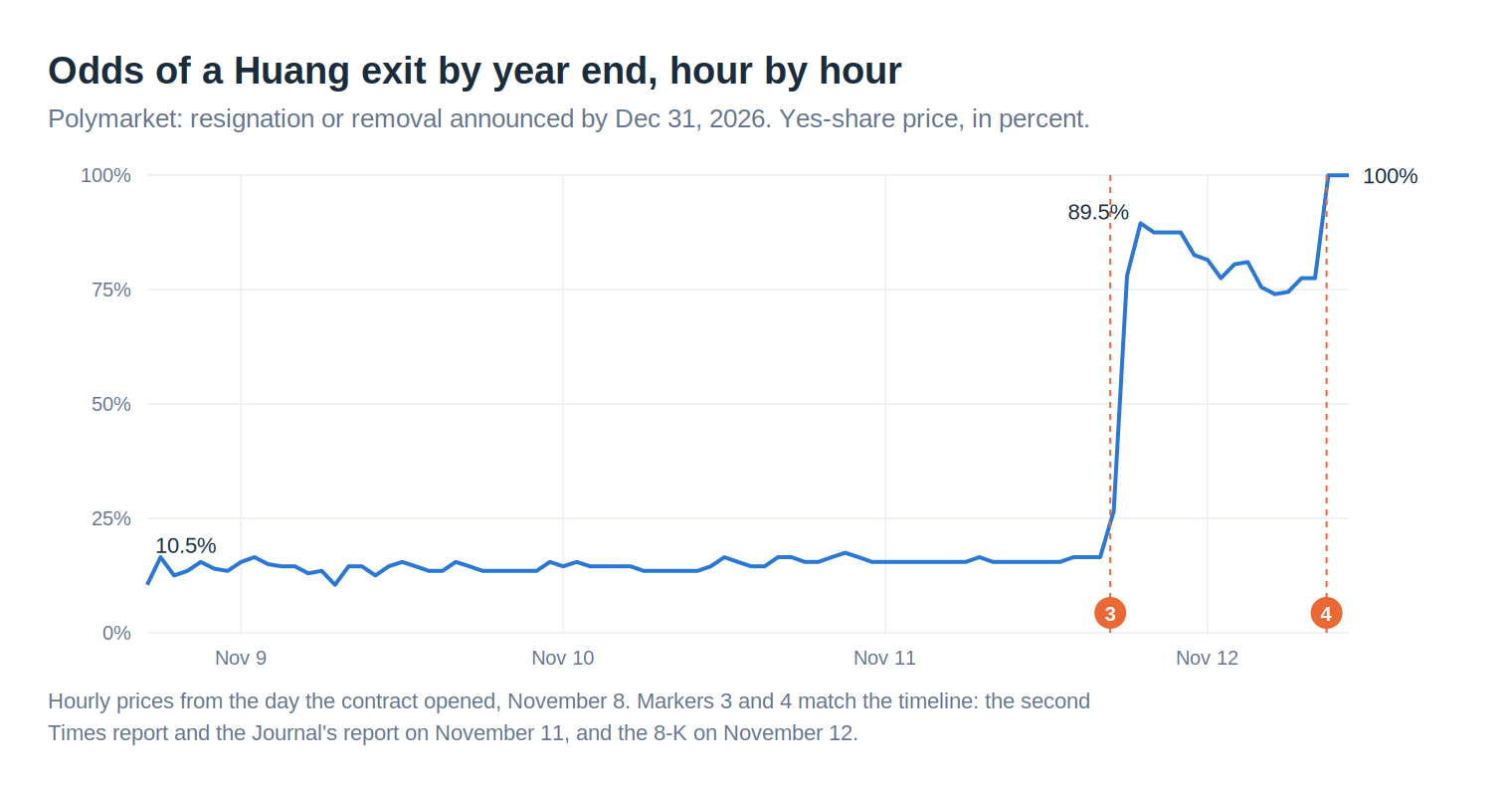
Polymarket's own price history shows the year-end contract between 10.5% and 17.5% from the day it opened, November 8, until 4 p.m. on Wednesday. It was 26.5% at 5 p.m., 78% at 6 p.m. and 89.5% at 7 p.m., then eased to about 74% overnight while the board met and Nvidia said nothing. It went to 99.95% by 9 a.m. Thursday, after the 8-K, and Polymarket resolved the contract Yes by late morning (Polymarket).
| When | Contract | Reading | Source |
|---|---|---|---|
| Nov 8 | Kalshi: Huang leaves before July 2027 | Peaked at 44%, then about 30% | Kalshi News |
| Nov 9, 1:46 p.m. | Kalshi: gone by 2027 / 2028 / 2031 | 17% / 30% / 75% | CNBC |
| Nov 9, 4:31 p.m. | Polymarket: exit announced by Dec 31 | 16% | Fortune |
| Nov 11, 9:53 a.m. | Polymarket: out by Dec 31 | 16%, after a 20% peak two days earlier | Yahoo Finance |
| Nov 11, evening | Polymarket year-end / Kalshi before Dec 1 | About 75% / about 80% | Startup Fortune |
| Nov 12, morning | Polymarket, every listed outcome from Nov 12 on | Resolved Yes, on $22.7 million of volume | Polymarket |
| Nov 12, 9:41 a.m. | Kalshi: Huang leaves as CEO, every deadline after Nov 12 | Settled Yes, on about 19.8 million contracts across the series | Kalshi |
For three days, Polymarket's year-end contract put the chance of an exit at about 13% to 20%; Kalshi's longer-dated contracts were higher, 30% to 52% for an exit before 2028. Polymarket moved to 75% and above only after the second report and the Journal's story, in the same hours the stock fell after the close. The markets did not anticipate the report that came just before his exit, and no contract let anyone bet on it directly. Some secondary accounts have the order reversed, saying the odds topped 75% and then fell to about 17%; the low readings came first.
The rules differ. Polymarket pays on an official announcement of resignation or removal, while Kalshi pays only when Huang actually leaves, with a December 1 deadline on its short contract (Startup Fortune). Polymarket resolved its contracts by late Thursday morning: Yes for November 12 and every later date, No for November 11. Because the resignation took effect immediately, Kalshi's test was met too, and it settled its contracts at 9:41 a.m. ET: Yes for every deadline after November 12, No for "before November 12", which had closed at midnight (Kalshi). Its market on the next CEO including interim appointments settled on Kress five minutes later (Kalshi). Liquidity was thin: on November 9, three outlets quoted Kalshi's odds of an exit before 2028 at 30%, 36% and 52% at different times of day, and Fortune put volume at about $266,000 (CNBC; Kalshi News; Fortune).
The succession market is thinner still. At about 4:20 p.m. Thursday, Polymarket's next-CEO market had Ian Buck at 38.5%, up from 33.5% at 11:40 a.m., and Kress at 15%, down from 23%. Arm's Rene Haas was at 10%, "no change" at 4.6%, Tim Cook at 4.5%, Jay Puri at 3.3%, CTO Michael Kagan at 2.9% and AMD's Lisa Su at 2.2%, on $764,000 of volume (Polymarket). Apple's Johny Srouji showed about 13%, but on about $2,000 of trading and a wide gap between the bid and the ask. Kalshi's market on the permanent CEO, which does not count interim appointments, told a similar story at about 4:35 p.m.: Buck 39%, Kress 13%, Haas 11%, Srouji 9% and Huang himself 4% (Kalshi). President Trump wrote on Truth Social shortly after the announcement that Tim Cook, Apple's executive chair since September, should take the job: "A Legend replaces a Legend!" (NBC News). At these sizes the markets are a sentiment gauge, not a forecast. Our prediction markets page tracks the larger contracts.
What Wall Street Did
At least nine firms downgraded Nvidia in about a day:
| Firm (analyst) | Action | Price target | Source |
|---|---|---|---|
| Baird (Tristan Gerra) | Outperform to Neutral, Nov 11 | $500 to $200 | 24/7 Wall St, via Yahoo Finance |
| Bernstein (Stacy Rasgon) | Outperform to Market Perform | $400 to $200 | CNBC |
| Melius (Ben Reitzes) | Buy to Hold | $315 to $185 | CNBC |
| Evercore ISI (Mark Lipacis) | Outperform to In Line | $465 to $186 | CNBC |
| Oppenheimer (Rick Schafer) | Outperform to Perform | Target removed | CNBC |
| William Blair, KeyBanc | Downgraded | None | CNBC |
| Truist | Buy to Hold, Nov 12 | $346 to $174 | Motley Fool |
| Craig-Hallum | Buy to Hold, Nov 12 | $275 to $180 | Motley Fool |
| Stifel (Ruben Roy) | Buy kept | $315 to $205 | Yahoo Finance |
| Citi (Atif Malik) | Buy kept | Cut to $225 | CNBC |
| Morgan Stanley, Bank of America | Ratings kept; both took it off their top-pick lists | $300 / $350 | 24/7 Wall St, via Yahoo Finance |
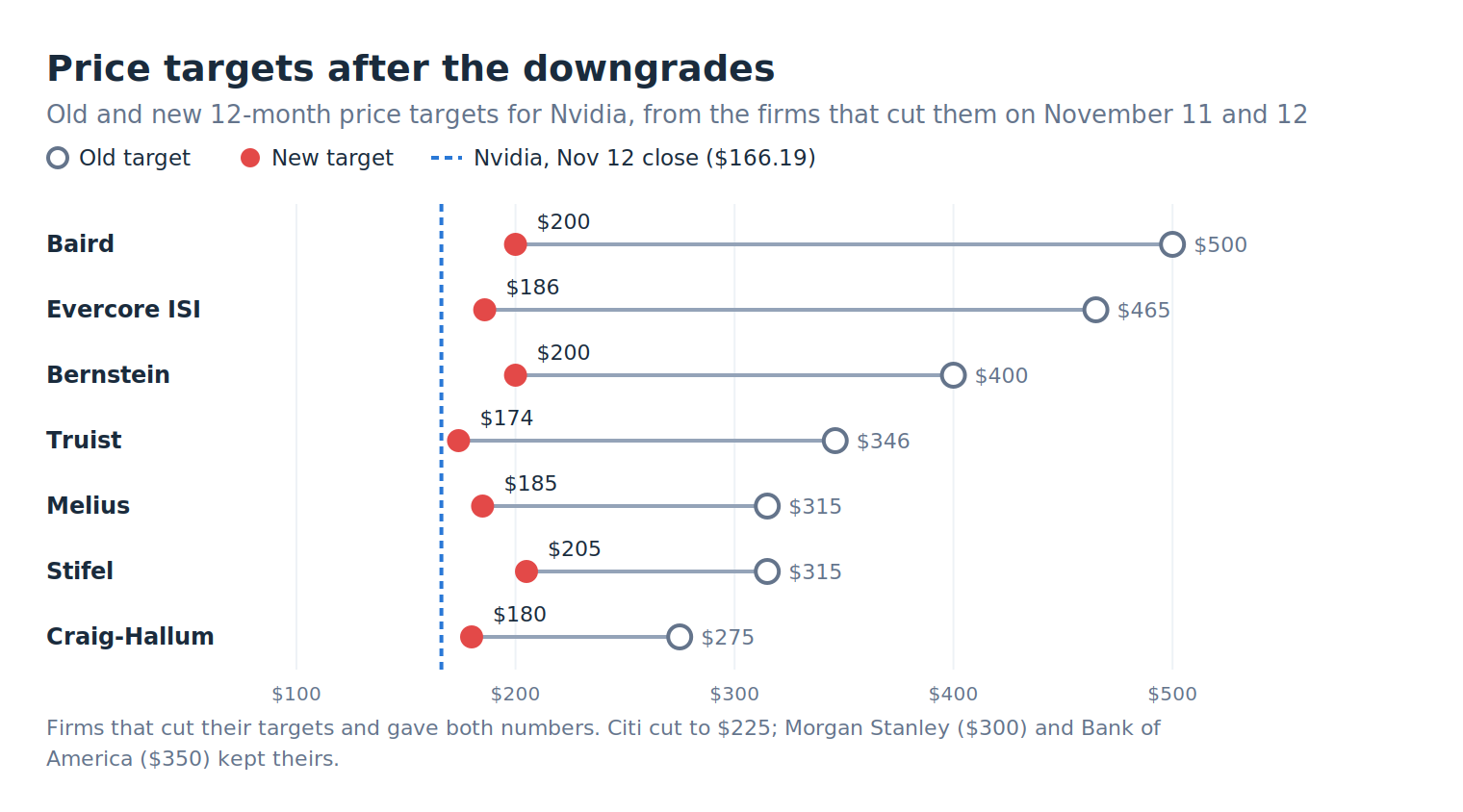
Every new target in the chart is still above Thursday's close, though Truist's $174 and Craig-Hallum's $180 are only about 5% and 8% above it. Most of the cuts took targets down to where the stock had been trading a week earlier, not below it. Truist said "risks are more relevant than valuation," pointing to Nvidia's culture and to whether its chips reached buyers in China, and Craig-Hallum said Huang's exit leaves "a big hole" at the top (Motley Fool).
The bulls and the bears agree that near-term earnings are intact. They disagree about what multiple an Nvidia without its founder deserves. Stifel expects a modest beat on November 17 but cut the multiple it applies from 20 to 13 times its fiscal 2028 earnings estimate of $15.65 a share. Citi notes the stock trades near 11 times earnings, about where it bottomed before (Yahoo Finance). Oppenheimer's Schafer said there were huge shoes to fill, no obvious successor and a risk that senior people leave (Yahoo Finance).
Before the resignation, analysts told CNBC a departure could take 20% off the stock (CNBC), and Dan Ives put fair value at $300 with Huang and $225 without, a 25% discount (CNBC). The answer depends on the starting point. Measured from the last close before Huang's admission, November 6, the stock was down 20.3% at Thursday's low, roughly the 20% the Street had talked about, and 11.0% at the close. Measured from Wednesday's close, it was down 13.1% at the open and 4.3% at the close.
The Board
Nvidia's 2026 proxy describes a board with no chair by design. It had an independent lead director, Stephen Neal, so that every member had an equal voice; nine of the ten nominees were independent; and Tench Coxe and Harvey Jones had served since 1993. Suzanne Nora Johnson joined in July, so with Huang gone the board has ten members, all independent (2026 proxy). Neal is chairman emeritus of Cooley, the law firm that has been Nvidia's main outside counsel for about three decades, and CNBC said that made his role in the investigation significant (CNBC). Average director tenure is almost 15 years, according to Semafor, about twice the S&P 500 norm (The Next Web). Nvidia has no chief compliance officer; a committee of the CFO, the head of operations and the head of human resources handles compliance (Fortune).
Yale's Jeffrey Sonnenfeld and Steven Tian argue that the board passed every checklist proxy advisers use (an independent majority, a lead director, annual elections, one share class) and still ignored red flags; they disclose that Huang has attended their CEO forums (Fortune). The University of Colorado's Ann Lipton put the investigation more bluntly: it would be exactly as thorough as the directors running it wanted it to be (TechCrunch).
The board disclosed what it had to and little more. The November 8 and November 10 statements went out as press releases; EDGAR shows no Nvidia 8-K between September 3 and November 12 (EDGAR). Opening an internal investigation does not require an 8-K; an officer's departure does. The resignation 8-K does not mention the investigation, national security or a reason. It also lists no separation terms, and the proxy says Nvidia has no employment, severance or change-in-control agreements with its named executives. Its clawback policy is triggered only by a financial restatement. Unvested stock awards are normally forfeited on a resignation unless the board decides otherwise, but Nvidia has not said what happens to Huang's. The board chose Jones, a former Synopsys chief executive, as chair rather than Neal. No source says why.
The Lawsuits
The Rosen Law Firm filed a securities class action in federal court in San Jose minutes after the November 9 close, on behalf of investor Mark Kistenmacher, against Nvidia and Huang (Decrypt; CNBC). It points to four statements: two from an Nvidia spokesperson in October 2025 (that staff found no evidence of diversion at Megaspeed, and that Huang's customer visits were routine), the October 2026 statement that his interactions with Alice Huang were not unusual, and Huang's own October 2026 remark to Bloomberg that his Megaspeed dealings were normal (Decrypt). The class period runs from October 9, 2025 to November 8, 2026, and the deadline to ask to lead the case is January 8, 2027 (Rosen Law Firm, via PR Newswire). Because that period ends before the November 9 to 12 declines, expect amended or new complaints with a longer one. Securities fraud turns on whether someone lied to investors, Lipton noted, which is why the case is built on the denials, not on the affairs.
The bigger case may come from Delaware: a claim that directors consciously ignored red flags in their oversight of the company, known as a Caremark claim. Sonnenfeld and Tian list the flags they see: a Megaspeed affiliate's purchases of about $4.8 billion of Nvidia-powered equipment in under two years, continuing after Megaspeed was reported in October 2025 to be under investigation for export evasion, a short seller's report alleging close ties between the two Huangs, a trade-compliance committee that met three times, no compliance chief and no successor (Fortune). No derivative suit, SEC inquiry or charge against Huang had been reported as of Thursday morning. Research supports the expectation of more to come: Cline, Walkling and Yore found that executive indiscretions are followed by more shareholder lawsuits on unrelated matters and more Justice Department and SEC investigations (Journal of Financial Economics). Kress will sign the next Sarbanes-Oxley certifications as both CEO and CFO.
Washington
The House request was addressed to Huang personally; he has since agreed to testify (below), and it is unclear whether the November 18 briefing itself goes ahead. Moolenaar framed three questions: whether Huang shared privileged information with a spy, whether he was influenced to lobby against limits on chip sales, and whether China got preference for Nvidia's scarce advanced chips (CNBC). On November 11, Senators Elizabeth Warren and Chris Coons wrote to Secretary of State Marco Rubio, the White House's Stephen Miller and Commerce Secretary Howard Lutnick, asking the administration to preserve its records on Nvidia's China exports and confirm it by November 17, the day Nvidia reports (Fox Business). Fox Business also reported that Megaspeed has bought more than $4.8 billion of advanced Nvidia chips since June 2024. House Foreign Affairs chairman Brian Mast said Thursday that Huang, threatened with a subpoena, agreed to testify before Thanksgiving, likely under oath, transcribed and on video (Yahoo Finance live; Al Jazeera). Kalshi's contract on whether he testifies before Congress by December 1 traded at 83% that afternoon; its rules count an appearance in an official proceeding the committee authorizes, not only sworn hearings (Kalshi).
Thursday brought more from the Justice Department. Semafor, citing two administration officials, reported three matters: an antitrust probe focused on Nvidia, and two inquiries into Megaspeed and Super Micro that have focused on Alice Huang, with no indication that the department would seek criminal charges against Nvidia or Huang at this time (Semafor). Attorney General Todd Blanche told reporters the department had not reached a conclusion on whether Alice Huang was a Chinese spy, and that "of course" the FBI was investigating the reports (Reuters, via Yahoo; CNN). Commerce Secretary Howard Lutnick, who like Huang pushed to relax chip sales to China, faces growing questions of his own. Reuters reported, citing two people familiar with the situation, that senior White House officials were discussing whether he should be pushed out, while a White House official said Trump "maintains complete confidence" in him (Reuters, via Devdiscourse). Senate Majority Leader John Thune said he expects Lutnick to testify before the Senate on Nvidia and chip sales to China (CNN).
Senate Democratic leader Chuck Schumer is pushing three bills on chip exports, the AI Overwatch Act, the MATCH Act and the Chip Security Act (CNBC), and lawmakers are trying to attach them to the annual defense bill (CNBC). Democrats take control of both chambers in January. Senator Kevin Cramer and Representatives Suhas Subramanyam and Don Bacon had called for Huang to resign before he did (CNBC).
The administration has defended Huang personally. President Trump called him honorable and said Huang told him he had no idea she was a spy (NBC News; Decrypt). The Justice Department has taken over a federal investigation of Megaspeed; the Times does not say it involves Huang (via The Nightly). For the company, the exposure is mostly regulatory and political: tighter licensing for China sales, rules requiring chipmakers to verify where chips end up, and hearings run by the other party. Huang's exit removes the person at the center of the story. It does not remove the record.
Who Runs Nvidia Now
Kress, 59, joined Nvidia as CFO in September 2013 after three years in senior finance roles at Cisco and 13 years at Microsoft, four of them as CFO of its Server and Tools division, and before that worked in finance at Texas Instruments (Nvidia, 2013; Reuters, via The Star). She sets Nvidia's guidance and has been on its earnings calls for 13 years. Nvidia named no acting CFO, so she holds both jobs. eToro's Josh Gilbert called her the obvious choice to steady the ship but expects an engineer to get the permanent job (Reuters, via The Star).
Jones, 73, co-founded Daisy Systems, ran Synopsys from 1987 to 1998 as CEO and then executive chairman, co-founded Tensilica and runs Square Wave Ventures. He has been an Nvidia director since 1993 (2026 proxy). In emails to staff on Thursday, obtained by CNBC, Kress wrote "I believe deeply in this company and in its future" and called a company meeting for November 18 at 9 a.m. PT, and Jones called her "a key architect of NVIDIA's growth and capital strategy" (CNBC).
Boards that lose a CEO suddenly, often over conduct, tend to name the CFO as interim:
| Case | Interim | Outcome | Time to a permanent CEO | Source |
|---|---|---|---|---|
| Boeing, 2005 | CFO James Bell | Outsider Jim McNerney, from 3M | About 16 weeks | Boeing 8-K |
| HP, 2010 | CFO Cathie Lesjak | Outsider Léo Apotheker, from SAP | About 8 weeks | TechCrunch |
| Intel, 2018 | CFO Bob Swan | Swan, made permanent | About 7 months | CBS |
| BP, 2023 | CFO Murray Auchincloss | Auchincloss, made permanent | About 4 months | Reuters, via Yahoo Finance |
| Intel, 2024 (performance, not conduct) | CFO David Zinsner and Michelle Johnston Holthaus | Former director Lip-Bu Tan | About 3.5 months | Engadget |
In those five cases the search took two to seven months and split about evenly between promoting the interim and going outside. Across the S&P 500 in 2025, 73% of new chief executives were insiders (Spencer Stuart). Research by Ballinger and Marcel links interim periods with weaker performance while the interim serves (Strategic Management Journal).
Nvidia named no candidates. Ian Buck, who led the development of CUDA and runs the hyperscale business, is the internal name analysts cite most; Futurum Equities' Shay Boloor called him the strongest long-term internal candidate (Reuters, via The Star). CNBC's list adds Kress, Bryan Catanzaro, Michael Kagan and chief scientist Bill Dally (CNBC live). Outside names in the press include Arm CEO Rene Haas, a former Nvidia executive, whom a banker told Reuters made the most sense (Reuters, via The Star), and Apple hardware chief Johny Srouji, whom Bloomberg reported one source said was under consideration (24/7 Wall St, via Yahoo Finance). All of this is speculation.
The harder problem is how Huang ran the company. He had dozens of direct reports (33 this week by CNBC's count of internal records, about 60 by his own count) and no chief operating officer (Fortune; The Next Web), and he never named a successor. Nvidia's annual report warns that it depends on its long-serving executive team and that poor succession planning could hurt it, but does not name him (The Next Web). A CFO running the company in the interim either takes on all of those direct reports or adds a layer of management between them and the top, and either choice changes how Nvidia works.
What It Means for the Business
Nvidia says operations, customer commitments and the product roadmap continue "without interruption" (Nvidia). The roadmap Huang presented has Vera Rubin shipping in volume in the second half of 2026, Rubin Ultra in 2027 and Feynman in 2028 (The Next Platform). None of the reporting so far points to a change in that schedule.
The exposure is in the deals Huang fronted himself. The OpenAI arrangement had already shrunk from a $100 billion letter of intent to roughly $30 billion while he was CEO (Bloomberg; Tech Times). Nvidia closed a $5 billion investment in Intel in December 2025 (Cyprus Mail) and committed up to $10 billion to Anthropic (Yahoo Finance live). The most exposed business is China, because the scandal is itself an export-control story. As of Thursday morning no major customer or partner (Microsoft, Meta, Alphabet, Amazon, Oracle, OpenAI or TSMC) had commented publicly.
The first test is Tuesday, November 17: results at about 1:20 p.m. Pacific and the call at 2 p.m., unchanged from the original schedule (Nvidia). The question on the call is less the quarter than the next one, and who answers it. Inside the company, a Blind poll of 232 employees on November 9 and 10, before the second report, found 88% wanted Huang to stay (Investing.com, via Yahoo Finance). Huang has said he made more of his managers billionaires than any other CEO (Fortune), which means many of the people a successor needs to keep do not need the paycheck. No departures or retention grants have been reported.
What History Says
CEO Exits Over Conduct
| Company, year | CEO and reason | Who took over | First-day move | Source |
|---|---|---|---|---|
| Boeing, 2005 | Harry Stonecipher; relationship with a Boeing executive | CFO as interim, then an outsider | -0.1% | New York Sun |
| HP, 2010 | Mark Hurd; concealed relationship with a contractor, inaccurate expense reports | CFO as interim, then an outsider | About -8% the next session; -9.7% after hours on the day | AP, via Washington Times |
| Intel, 2018 | Brian Krzanich; past relationship with an employee | CFO as interim, then made permanent | -1.3% to -2.4% | BetaNews; HotHardware |
| McDonald's, 2019 | Steve Easterbrook; relationship with an employee | Insider named at once | -2.7% at the close; down 3% during the day | CNBC |
| BP, 2023 | Bernard Looney; undisclosed relationships with colleagues | CFO as interim, then made permanent | -2.7% in London | AFP, via Malay Mail |
| Kohl's, 2025 | Ashley Buchanan; undisclosed vendor dealings tied to a personal relationship | Chair as interim, then made permanent | +8.4%, on the same day as strong preliminary results | AP, via KSL |
| Nestlé, 2025 | Laurent Freixe; undisclosed relationship with a direct subordinate | Insider named at once | -0.7% | Reuters, via Yahoo Finance |
| Nvidia, 2026 | Jensen Huang; reported relationship with a direct report, amid reports of ties to an alleged spy | CFO as interim, open search | -4.3% at the close; -14.4% at the low | This post |
HP's next-session move is our calculation from its $46.30 close on August 6, 2010 to $42.60 on August 9, and McDonald's close is our calculation from $193.94 to $188.66; Bloomberg called it the stock's biggest drop in six years (Bloomberg).
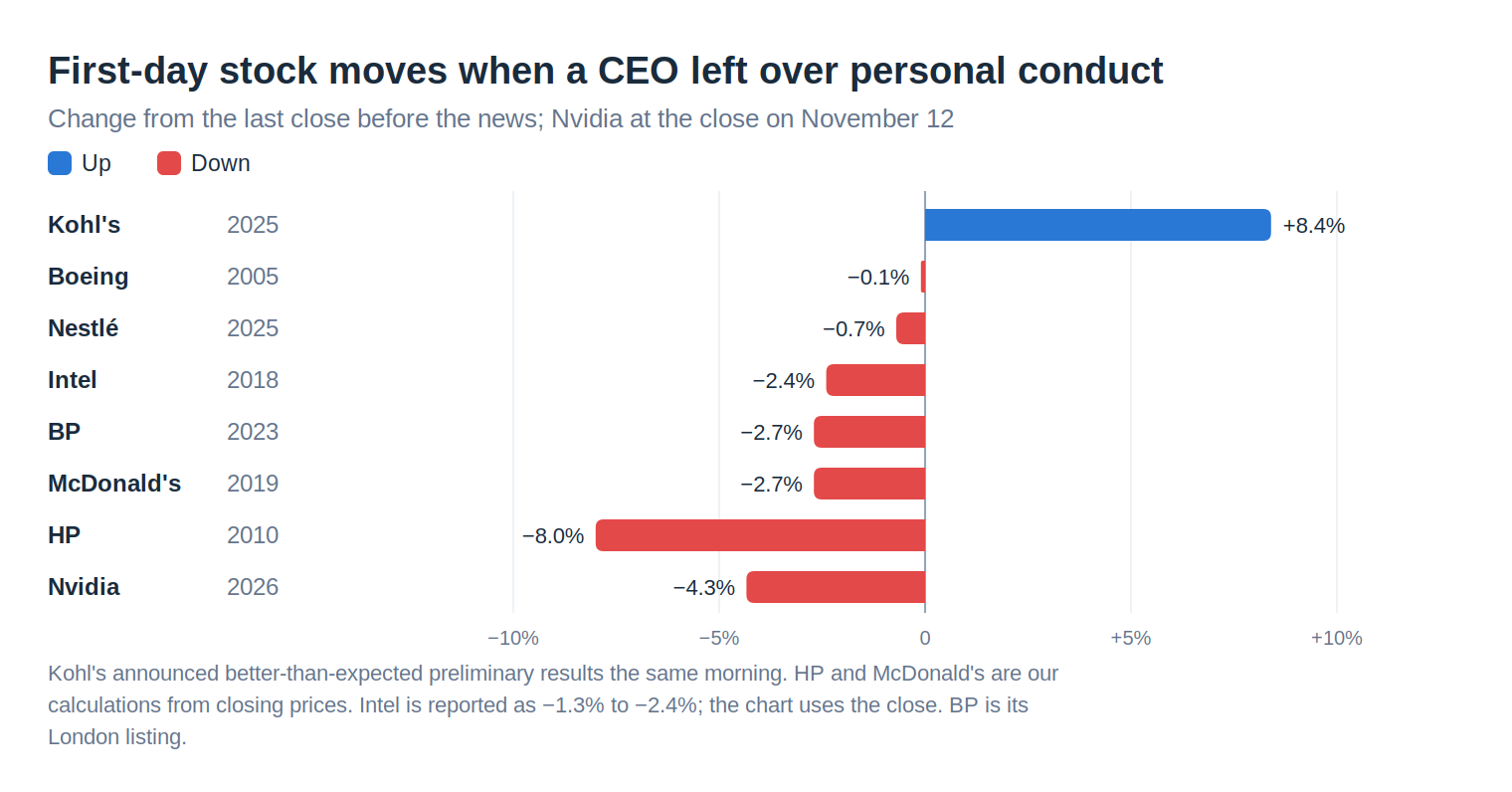
The first-day hit was small when the board named a credible insider at once (McDonald's, Nestlé) or when the market saw the CEO as replaceable (Boeing). It was largest at HP, where Hurd was credited with the company's turnaround, the CFO stepped in and the successor was undecided. Nvidia matches the HP setup and adds two things HP did not have: a founder who ran the company for 33 years, and a national security investigation.
The Months After
The first day is the least informative part of these stories. We followed the same seven stocks for a year from the last close before the news and compared each with the S&P 500.
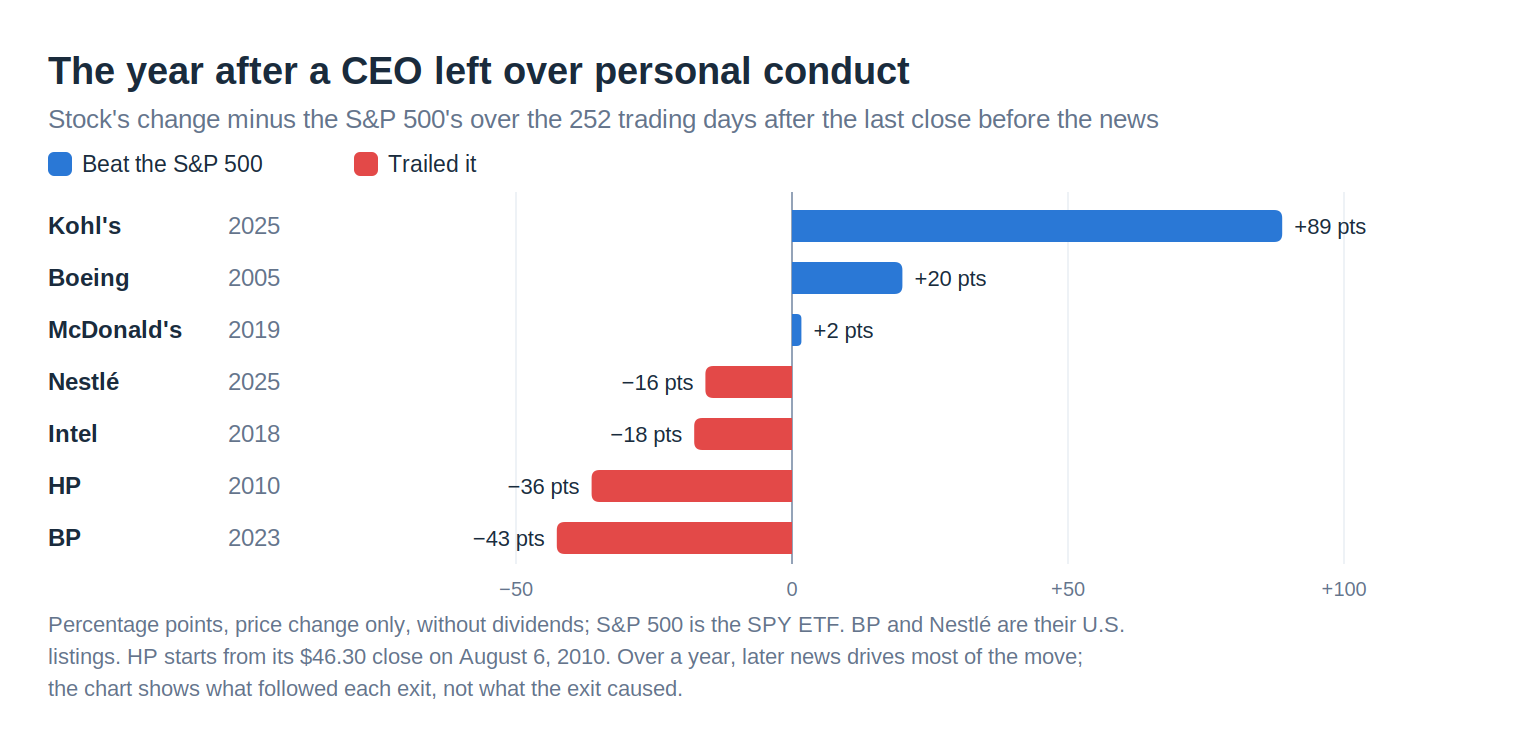
| Company, year | 1 month | 3 months | 1 year | Stock alone, 1 year |
|---|---|---|---|---|
| Boeing, 2005 | +3.6 | +12.9 | +20.0 | +24.4% |
| HP, 2010 | -11.4 | -13.6 | -36.3 | -29.5% |
| Intel, 2018 | -4.2 | -19.2 | -17.7 | -11.2% |
| McDonald's, 2019 | -1.5 | +3.2 | +1.7 | +9.6% |
| BP, 2023 | +3.1 | -11.2 | -42.6 | -19.0% |
| Kohl's, 2025 | +15.0 | +47.8 | +88.8 | +118.8% |
| Nestlé, 2025 | -5.8 | -0.1 | -15.7 | +2.4% |
Our calculations from daily closes, price change only. The first three columns are the stock's change minus the S&P 500 ETF's, in percentage points. BP and Nestlé are their U.S. listings, and HP starts from its $46.30 close on August 6, 2010.
Four of the seven trailed the market a year later, by a median of about 16 points, close to Yahoo Finance's Jared Blikre's count of four of six (Yahoo Finance live). The first day was a poor guide: Boeing and Nestlé both moved less than 1% on day one and ended the year 36 points apart. Over a year, the exit competes with everything else that happens to a business, so the table shows what followed, not what the exit caused, and seven cases are too few for a rule. One detail fits Nvidia's setup uncomfortably well: three of the four companies that made the CFO interim chief, HP, Intel and BP, trailed the market by 18 to 43 points. Boeing, the fourth, beat it.
What Surfaced Later
The other lesson is that these stories rarely end with the resignation.
| Company | What came later | Months after the exit | Source |
|---|---|---|---|
| McDonald's | The board sued Steve Easterbrook after a tip led to evidence of more relationships; he returned more than $105 million; the SEC fined him $400,000 and barred him from serving as an officer or director for five years | 9, 25 and 38 | HR Dive; CBS News; SEC |
| CBS | The board found cause and withheld Les Moonves's $120 million severance; a securities class action settled for $14.75 million; a New York attorney general settlement of $30.5 million followed, after it emerged that a police captain had tipped off the company | 3, 43 and 50 | KTVQ; D&O Diary; New York AG |
| Wynn Resorts | Massachusetts fined the company $35 million after Nevada's $20 million fine; a derivative settlement paid the company $41 million, $20 million of it from Steve Wynn; a securities suit settled for $70 million | 15, 21 and about 80 | CBS Boston; CDC Gaming; PR Newswire |
| BP | The board dismissed Bernard Looney for serious misconduct after finding he had knowingly misled it, putting up to £32.4 million of pay at stake, most of it forfeited automatically | 3 | Fortune |
| HP | HP sued Mark Hurd when Oracle hired him, and he gave up about $13.6 million of stock to settle; a Delaware suit over his severance was dismissed | 1 and 22 | AP, via Phys.org; Computerworld; RLF |
Boards that found more after an exit went after the money, and the worst facts sometimes came out years later. Reuters' report on Thursday of a relationship with a second Nvidia employee is the kind of finding that, at McDonald's, turned an exit without cause into a lawsuit nine months on.
Founder Handoffs
Planned founder handoffs barely moved the stock. Apple fell 5% after hours when Steve Jobs resigned in 2011 and closed only slightly lower the next day; analysts pointed to Tim Cook's record running the company while Jobs was on leave (Fortune; BetaNews). Amazon closed down about 2% after Jeff Bezos announced his handoff to Andy Jassy alongside quarterly results (TechNews, citing Barron's). Alphabet edged up when Larry Page and Sergey Brin stepped back in 2019, keeping control through their super-voting shares (Fortune).
The forced exit closest to Nvidia's is OpenAI's in November 2023. Microsoft fell 1.7% the day Sam Altman was fired and closed at a record on the next trading day after hiring him (CNN). Nearly all of OpenAI's roughly 770 employees threatened to leave, and Altman was back within days with a new board (PBS NewsHour). At Nvidia, that ending would take a decision by the same board: Huang has no extra votes and no seat.
The Research
| Study | Sample | Finding |
|---|---|---|
| Cline, Walkling and Yore (2018), Journal of Financial Economics | 325 executive indiscretions | Average loss of 1.6%, or 4.1% when the CEO is involved; afterwards, lower margins, lost business partners, more lawsuits and more investigations |
| Borelli-Kjaer, Schack and Nielsson (2021), Journal of Corporate Finance | About 200 sexual-harassment scandals | About -1.5% over two days; only half recovered later |
| Israelsen and Yonker (2017), Journal of Financial and Quantitative Analysis | Firms that rely on key people | The most exposed firms lose 8% when a key employee leaves |
| Fahlenbrach (2009), Journal of Financial and Quantitative Analysis | Large U.S. firms, 1993 to 2002 | Founder-led firms beat others by about 8.3% a year, 4.4% after controls |
| Quigley, Crossland and Campbell (2017), Strategic Management Journal | 240 sudden CEO deaths, 1950 to 2009 | Stock reactions to losing a CEO grew larger over the decades |
| Nguyen and Nielsen (2014), Management Science | 149 sudden deaths, 1991 to 2008 | 42% of reactions were positive; the authors advise boards to build strong deputies |
Nvidia's drop at Thursday's low was three and a half times the 4.1% average for a CEO indiscretion, and its 4.3% drop at the close was a little above that average, about half the 8% loss for the firms most dependent on key people. The research suggests why. Founder-led firms earn a premium that appears to be real, and markets have reacted more strongly over time to losing a CEO, with bigger drops when the CEO was highly regarded, so a founder's exit in 2026 should cost more than the average in older samples. The study that most clearly finds markets welcoming a leader's departure (Salas, 2010) involves long-serving executives at underperforming companies, which does not describe a company that was the first to reach a $5.5 trillion market value in May (Fortune). And Nguyen and Nielsen's advice to build strong deputies describes what Nvidia's flat structure did not have.
The bull case is still a real one. Citi says the stock trades near 11 times earnings and Goldman Sachs puts it at 12 times even in a 2028 case with no growth, low for Nvidia (Yahoo Finance; 24/7 Wall St, via Yahoo Finance). Penn law professor Jill Fisch expects only a small effect on long-term value (Fortune). And the founder handoffs that ended well were followed by years of strong returns. Those had a successor already running the business. Nvidia does not yet have one.
What Could Come Next
None of this is a forecast. The first day is over. What moves the stock from here is the November 17 report, the choice of a successor, and a legal and political process that, on past form, runs for years.
The Stock
The options market prices a move of about 9.5% either way by November 18, the day after the report. After that, history offers base rates, not predictions: in our seven cases the median stock trailed the S&P 500 by about 16 points over a year, and in the interim periods we looked at, the search for a permanent chief executive took two to seven months. The new analyst targets sit about 5% to 50% above Thursday's close, and the bulls point to a valuation near 11 times earnings. The bears point to everything below.
The Lawsuits
The securities class action follows a fixed schedule. Investors who want to lead it must apply by about January 8, 2027, and the court should name a lead plaintiff within 90 days of the first notice, around February. A consolidated complaint and a motion to dismiss follow, and the law freezes all discovery while that motion is pending (15 U.S.C. 78u-4). When judges ruled on such motions over the past decade, they granted 62% of them, and the median dismissed case took about a year and a half (NERA, via D&O Diary; Cooley). Cases that survive usually settle: the median settlement in 2025 was $17.3 million, about three and a half years after filing (Cornerstone Research). On that schedule, if the suit survives, depositions of Huang and the directors would most likely come in 2028 or later; that is our estimate, not a court date. Nvidia knows how long it can take. A class action over its crypto-mining disclosures, filed in December 2018, went to the Supreme Court and back and was certified as a class only in March 2026, with no trial yet (Nvidia 10-Q).
Delaware can move faster at the start. A shareholder can demand Nvidia's books and records under Section 220, usually the first step toward an oversight claim; since a 2025 amendment that reaches board and committee minutes and the materials given to the board, but not emails unless a court finds a compelling need (Cooley). Boeing's demand after the 737 MAX crashes produced more than 640,000 pages and led to a $237.5 million settlement, paid by its insurers, about three years after the first crash (K&L Gates). Oversight claims are hard to win; about a quarter survive a motion to dismiss (CLS Blue Sky Blog). A 2023 Delaware ruling in a McDonald's case held that officers, not only directors, owe a duty to act on red flags, though that suit was later dismissed on procedural grounds (Potter Anderson; Simpson Thacher). That matters for an interim chief executive who has been CFO throughout.
Congress and the Justice Department
Congress can move in weeks. Wells Fargo's chief executive testified 12 days after his bank was fined in 2016, Mark Zuckerberg 24 days after the Cambridge Analytica reports in 2018, and Equifax's chief testified as a former CEO a week after he retired in 2017 (Fortune; PBS NewsHour; PBS NewsHour). Huang is on that track if Mast is right about testimony before Thanksgiving. Leaving Nvidia does not shield him, though a subpoena from this Congress would lapse in January and the new Democratic majority would have to issue its own (ABC News).
Export-control cases are slower, and the bills can be large. Seagate paid a $300 million penalty in 2023, about 19 months after its last shipment to Huawei; Cadence pleaded guilty and paid more than $140 million in 2025, about four and a half years after its first subpoena; and Applied Materials agreed in February 2026 to pay about $252 million, twice the value of its shipments and the most the law allowed (BIS; Justice Department; BIS). The civil limit is the greater of about $374,000 per violation or twice the value of the transaction (BIS). No export enforcement action against Nvidia has been reported, and nothing public says Nvidia broke the rules; the inquiries Semafor described center on Megaspeed, Super Micro and Alice Huang.
Huang's Pay
Nvidia has no employment, severance or change-in-control agreements with its executives (2026 proxy). Its standard award agreement stops vesting when employment ends, except at death, and forfeits unvested units (award agreement). Huang held 1,411,679 unvested restricted and performance units on January 25, before later vesting, valued at $264.9 million then and about $235 million at Thursday's close. The 8-K does not say how the board treated them. Nvidia's clawback policy is triggered only by an accounting restatement, not by misconduct (compensation recovery policy), so recovering pay he has already received would take the kind of lawsuit McDonald's filed. His 870.6 million shares are his own and not at stake.
What to Watch
| Date | What | Why it matters |
|---|---|---|
| Tue, Nov 17 | Third-quarter results, about 1:20 p.m. PT; call at 2 p.m. | Kress's first call as interim CEO; guidance for the next quarter; the options market prices about a 9.5% move by Nov 18 |
| Tue, Nov 17 | Deadline for the administration to confirm it is preserving Nvidia records | Signals whether the Warren and Coons inquiry escalates |
| Wed, Nov 18 | Requested House briefing; Nvidia company meeting, 9 a.m. PT | Who appears for Nvidia; what Kress tells staff |
| Before Thanksgiving (Nov 26) | Huang's testimony to Congress, according to Rep. Mast | Likely under oath, transcribed and on video; what he says about Megaspeed and Alice Huang |
| Before year end | Any separation terms for Huang in an amended 8-K | What happens to about $235 million of unvested stock |
| Open | An acting CFO, or a new management layer | Whether Kress keeps both jobs through the search |
| Open | The independent directors' investigation | Whether it continues, whether it takes in the relationship Reuters reported, and whether its findings are published |
| Jan 8, 2027 | Lead-plaintiff deadline in the class action | Amended complaints may lengthen the class period |
| About Feb 2027 | The court names a lead plaintiff | Then a consolidated complaint and a motion to dismiss; discovery stays frozen until a ruling |
| January 2027 | Democrats take both chambers | Chip export bills and hearings |
| 2 to 7 months | A permanent CEO, if the precedents hold | Insider or outsider, and whether it is an engineer |
| 2028 or later | Depositions, if the class action survives | Our estimate from median case timelines |
You can follow the stock, its options and insider filings on our Nvidia quote page and the earnings date on our earnings calendar.
This post covers events through about 4:30 p.m. ET on November 12, 2026, with Thursday's closing prices, and links to its sources throughout. Several claims in it, including the espionage allegations, the relationship with Powell, the one Reuters reported on Thursday and the Justice Department inquiries Semafor reported, are reports by news organizations that Nvidia has not confirmed; we say so where they appear. Stock, ETF and options figures are our own calculations from end-of-day and intraday market data, with market values based on 24.1 billion Nvidia shares outstanding. Nothing here is investment advice.
Comments (0)
No comments yet. Be the first.